Friday, May 25, 2012

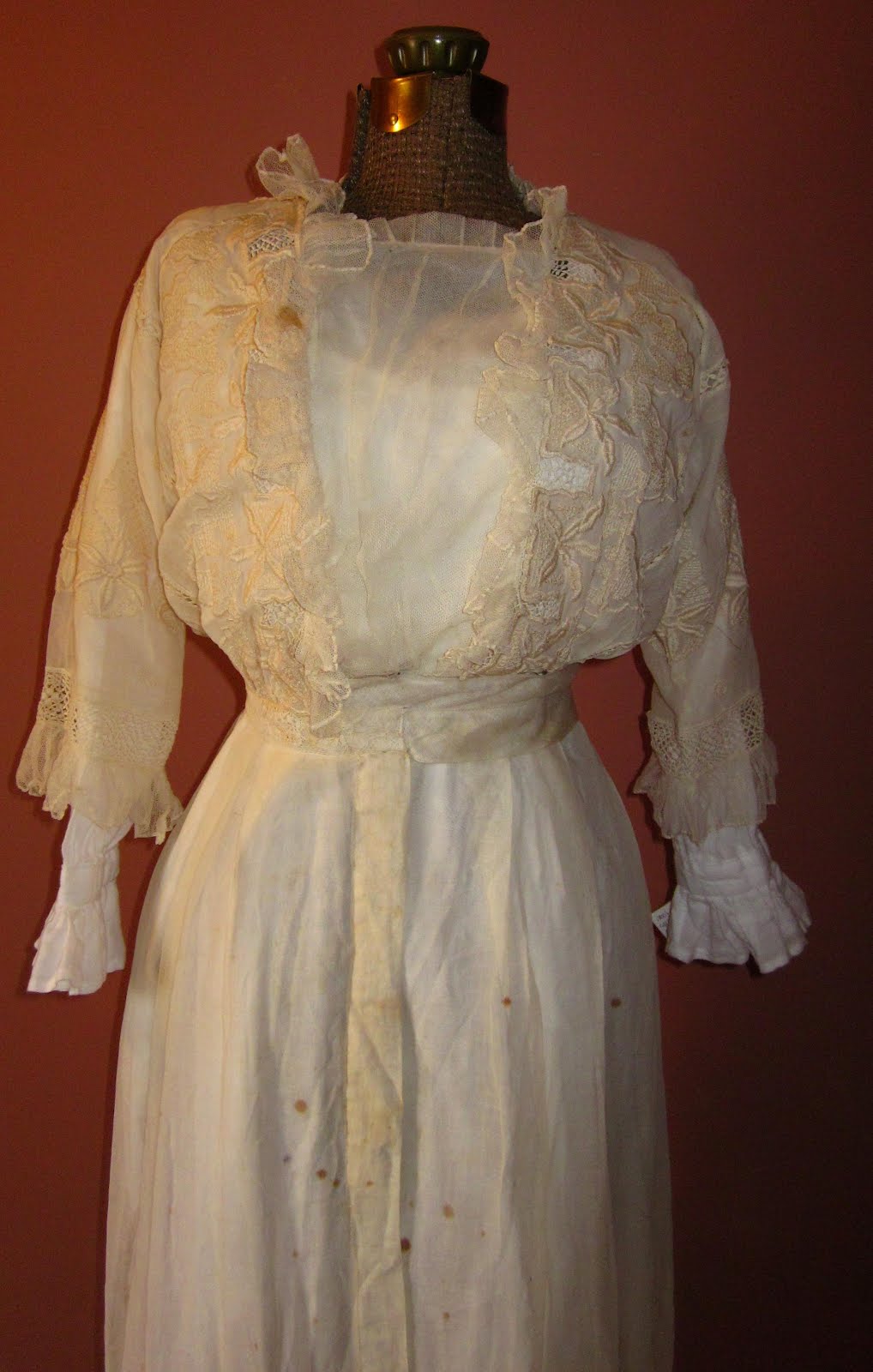
1880-1910? Walking Dress?


I was just gifted another lovely antique dress, and I honestly have no idea what the exact date of it could be.  Best guess is 1880-1910.

The dress has no accompanying information, other than "the Ashville, MA Historic Society didn't want this," and I'm more than delighted to have it!  Again, thank you Suzi!

The silk lining on the front of the jacket is in shreds, but I believe I can stabilize it without too much difficulty.  The top of the skirt is another matter.  I hesitate to even consider touching it, it's in such bad condition.  The bottom of the skirt is in perfect condition; unless you count a bit of drag-dirt as damage & some busted pick-up ties.
(skirt is a stock petticoat that just matched in color, not part of the original outfit!)

This is the front piece, it closes with 5 hooks & eyes at the back of the neck & then fastens on to the front by hooks & loops at the sides.  One side of the bottom front has been either taken out or torn out.  The original folds are still easily visible.


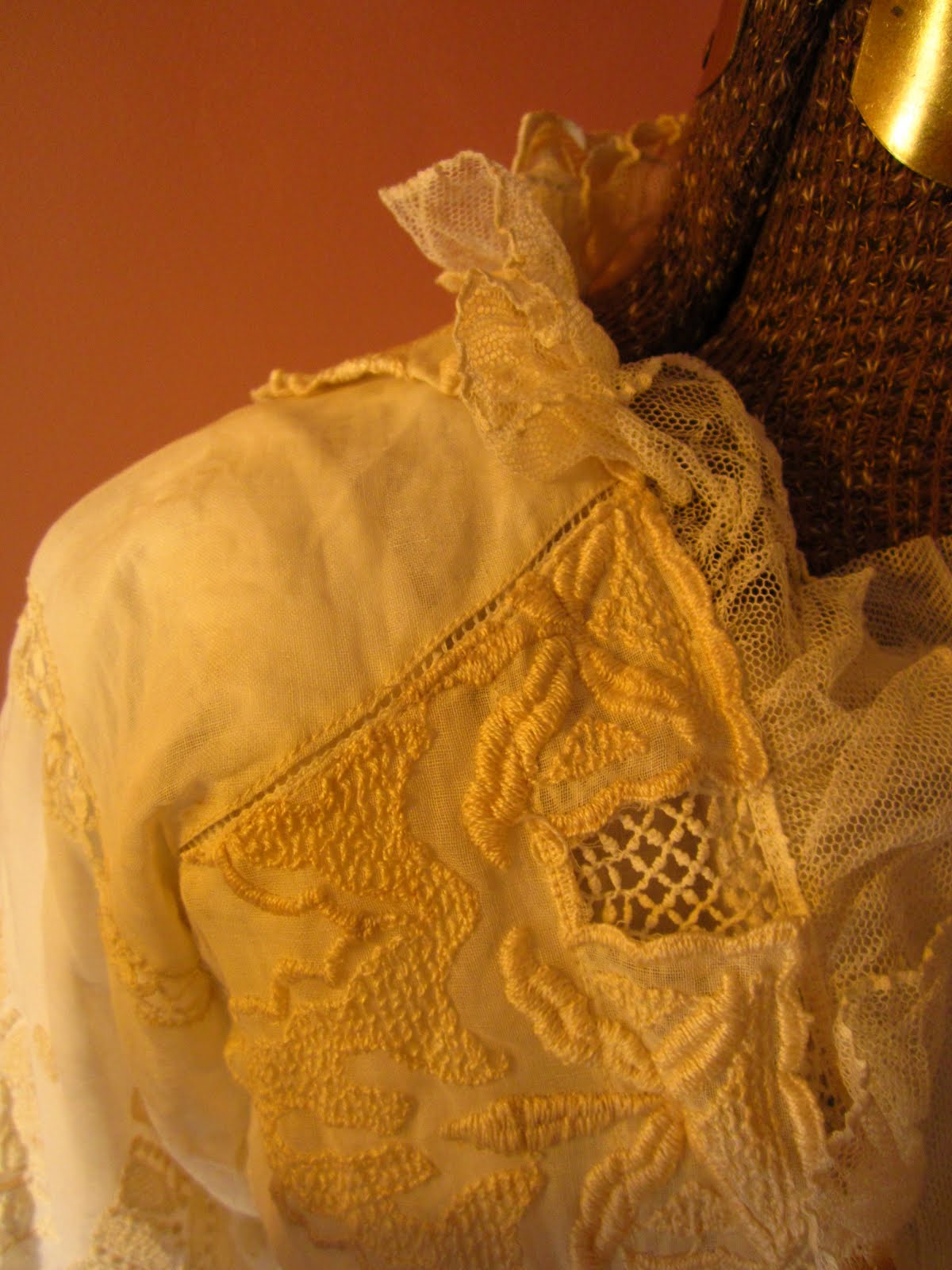
The embroidery is really quite striking & very Art Nouveau. 

It is in excellent condition, no picks, no runs, no damage of any kind.  The satin is in excellent condition.


The sleeves are absolutely lovely, and one of the things that makes me think "walking dress" over Day Dress or any other kind of gown.  It could also be a traveling dress, but as I don't know enough about this era, I really can't say.  Please don't take my word as golden, I'm out of my depth here. 

The right sleeve does have a couple blow-out places along the elbow,  but otherwise both sleeves are in excellent condition, including the underarm areas, both inside & out (amazing, really).


The back of this bodice is striking, and has a multitude of pin-tuck pleats.  I'm really thrilled with how charming the back is.

The entire garment is machine sewn, with a few hand-finished areas, like hooks & eyes.

I have (had) not photographed the skirt on a dummy because the silk is in terrible condition.  The waistband is completely shot and may not be repairable (but is a replacement!  Yay!).  The upper portion of the skirt is blown out in many vertical splits which are repairable with care. 

I believe that the silk was treated with some metallic solution to make it heavier, which was a common practice in the late 1800's & early 1900's, but that makes the silk very, very fragile. 


Suzi & I did put the skirt on one of her dummies, and at that point, I readjusted my estimate of 1910's back to a possible 1880's or mid-1890's.  The skirt appears to be a bell shape, but one that would go over a fairly large bustle & may have had an overskirt to match.  This may not be the case, and I will have to examine it a little more before I reach any definitive conclusions.

 It does have a wonderful silk bow that has frayed in it's tied state, and will remain so for as long as I own it.


I have very little experience with restoration, and so I'm not going to be diving into this project with any kind of urgency.  It's lasted this long, it can wait a few more years until I can either pay a professional or gain the skill necessary to save whatever can be saved. (Yes, it came in a garbage bag - much as all good "finds" do).

Ultimately, I will be making a pattern based off of this outfit, but for now it will get packed away in a nice, acid free box with tissue paper to help protect it.

Here it is just pinned on, but you can get the general idea of what the whole outfit looks like.


I laid the skirt flat so I could see what the general shape is, and it's a bell with a shorter front & longer back, cut in triangular gores, which probably have curved seams (but I haven't measured yet).  The wool is appliqued on & tucked up, and the bottom is quite stable. 

Here you can see the inside, which is interesting in itself.  I like the reinforcement areas of the black linen for the upper decoration.

Tuesday, April 10, 2012

18th c. American Women's "Jackets"

The question of late 18th c. women's jackets has come up on several blogs & discussions, and rather than Over-Post my findings in their comment sections, I'll post them here.

The results of my search are murky & not as overwhelmingly positive as I'd like, but I think we have a definitive "yes, jackets were worn in America" if we properly define "jacket."

A "jacket," by my definition (and backed by several written sources) is similar to "sweater" in terms of the broad use of the word.
Ex:
a sweater can be a
pullover,
cable knit,
cardigan,
vest,
v-neck,
turtleneck, etc.
Just as a jacket can be a
shortgown,
bedgown,
or even occasionally, pet-en-l-aire
waistcoat, (what reenactors improperly call a "bodice")
Brunswick style (with it's 12 names, but Irish Hood seems to be the preferred NY tag),
caraco (which just means "jacket", please stop calling it a "caraco jacket", but it is a specific cut)

BUT, for just a moment, I'm looking specifically for the jacket that Hallie Larkin of At the Sign of the Golden Scissors is talking about, which is a fitted back garment with front closure (either stomacher or straight) and skirts (either attached or separate seam) to no lower than mid-thigh level. If you aren't familiar with her blog, go read it. She is conservative in her research & refreshingly picky with her terms. (if you haven't figured it out, I'm a generalist).


I've found several written references to women wearing jackets, and a one example of an imported jacket that was owned by an American woman.

"Miss Patty Parsons, cut up the embroidered sky blue satin waistcoat which had been worn by her grandfather at the English court, and who fashioned therefrom a "jockey" which was deemed "wondrous becoming." 1775, America (probably Philadelphia)
"A troopers scarlet coat was made into a beautiful jacket for a fair girl, and from the little pieces cut from the coat-tails, lapels, etc, were fashioned a perfectly fitting pair of warm winter gloves, bound with gray squirrel fur which also furnished a collar and cuffs for the jacket." 1775, America.

However, most seem to be what we would otherwise call shortgowns, bedgowns, and other informal style "jackets." Names mean quite a bit if you can pin them down.

In the Virgin Islands, you can see the widespread use of the shortgown/waistcoat/jacket as the working woman's outfit. No, it's not continental America, but the Virginia slaves & white working class seem to wear almost the same things.
http://www.lennoxhonychurch.com/brunias.cfm

Here are some slave advertisements describing clothing worn when they ran away. I would call the illustration a shortgown or waistcoat, but it also has the very wide neckline & tabs or skirts of a working class "jacket," (illustration).
Outfits of matching fabrics, even if they are a petticoat & top are occasionally called gowns, though in this instance I think it's probably a genuine gown (written).
http://www.accessible-archives.com/2011/05/10-southern-us-slave-advertisements/

It is highly unlikely that we have many working-class jackets, as very few would have survived. The Pennsylvania shortgown survives as it was so prevalent through that area. There is a little debate about how widespread that style was, but there are enough records to support it's use through New England & the Middle Colonies. This particular "jacket" or shortgown was considered quite ugly by recent English immigrants, they were shapeless, often made of homespun & were said to be a single layer of fabric (so the quote says, though surviving examples are often reversible being made of 2 imported printed cottons).

There is a silk Spittalfields jacket of 1780 in rather poor condition (with provenance) that belonged to a woman in VT. Unfortunately I did not note the source of the image, I believe it was an auction site (Vintage Textile?), but it could have been Boston Museum of Art? I kick my years-ago self for not keeping better image records.

The Met has this jacket, which I would call a bedgown, listed as American or European - not definitive. The fabric is most likely European, but the garment assembly could be either.
http://www.metmuseum.org/collections/search-the-collections/80036043?img=0
When the museum doesn't know, causal researchers are in a hopeless bind.

It's important to remember that many people ordered the latest fashions from Europe, and that many competent seamstresses & tailors here re-created those styles. So it's plausible that English (Spittalfields) jackets were worn in our major urban hubs, and that many French fashions were also brought over. "A gown in the latest fashion" and "A suit in the latest fashion" are very common clothing order phrases. Also, to save money, people would often order a pre-cut, but un-sewn garment "to be made up."

I do think it's important to recognize that very few of the surviving examples of fancier jackets in the French & English style have American roots. The one above is the only example I've ever found that was definitely worn by an American woman, in America - though it was imported from England.
It's also important to remember that immigration has never stopped. People (women especially) did not just dump all their possessions in the Thames & arrive here in the Colonies with nothing but a shift on their backs. Trade, goods, people & their belongings & styles went back & forth across The Pond on a regular basis. Not everyone traveled, and not all the time, but we have enough evidence that we know America did not exist in a fashion vacuum.

This is not to say that I want to see hundreds of silk embroidered fancy jackets at every reenactment from Quebec to St. Croix. Research your fabrics, region, cut of the "jacket", station in life & other assorted necessities. But please don't hesitate to buy a good quality jacket/shortgown/waistcoat/caraco/Irish hood from vendors, or buy a pattern to make your own - as far as I can tell, they are correct for the Colonies and (in some cases) early America.

Saturday, March 10, 2012

1900-1918 Wedding Dress

This is a 1900-1918 wedding gown that I own. It was gifted to me by a friend many years ago & I've finally gotten around to photographing it.


The family story was that Grandma Bernice "Burnie" was married in this dress, in Australia - I believe just outside of Perth. 1908 is sticking in my head, but I just don't remember. She was a rancher and a rancher's wife, of small stature & slight figure, very wiry & tough. She lived to a ripe old age, had 7 children, and her wedding gown made it to America with one of her daughters, who's daughter then gave it to me because "you'll like it, it's just trash to me."
It's true that one woman's trash is another woman's treasure.


The dress is in near perfect condition. It is all machine sewn, and is made of early machine lace, netting & lightweight linen. It has some age stains on the front & is missing 3 snaps on the center back for the belt.
It fastens down the right side front with snaps & the belt wraps to the left with snaps.
The waist measures 22" when closed.
(pictured over one of my stock chemises)


It is not a rich woman's gown by any means, but is a lovely example of a working woman's wedding dress.


Now that I've shared it with you, I'm putting it back in it's box.

Friday, March 9, 2012

How to Phrase the Buckskin Dress Question?

Last week I received an e-mail from a (potential?/not?) customer that was innocuous enough until today. What brought this to the forefront was seeing a stunning leather dress made by a new FB friend, and talking with a different customer about the very same issue, which made me remember all the other women who have gotten dragged out of my store by their guys because "it's not a leather dress," and before you say, "it can't be that many, Gail" trust me - it's a lot... If as many girls that get told to wear leather wore it, we'd see a lot more girls wearing it.
It's bothering me enough to put the situation & question to you, Dear Readers.

Note: I'm not taking any orders right now, so unless she's buying something I have in stock it's not an issue for me, and I don't make leather dresses anyway - so it's just a matter of who I send her on to. But how/who to send her to?

Situation: She is very interested in getting into living history/rendezvous/Rev War, and her husband has been in it for quite some time.
Issue: She wants to dress Colonial, he wants her to wear a leather dress (no indication of tribe/nation or time frame, and she says he dresses Skinner).

First: I'm not a fan of buckskin dresses. When done well, they are stunning - when done poorly, well...
I don't like wearing them - they are cold & damp when it's cold, hot & sticky when it's hot, they make funny noises when I walk; they chafe, rub & pull; they stay wet once they get wet and they smell funny. They leave little flecks of leather-sweat-slime all over me. I'm self-conscious about my hips and they showcase my worst attributes at all times, and I can't stand to wear a bra with the dress, but I'm physically uncomfortable going without. Let's not even discuss keeping all that fringe away from porta-potty water (OK, fine, it's similar to the paniers in the pee-bucket issue -- those things are just not made for pre-20th c. women)...
Overall I'm just not a fan. So it's really hard for me to play them up to anyone... though when they are done well they are stunning.

Second: I'm just stubborn enough to be irritated at one person telling another person what to wear, especially when the person doing the telling isn't the one doing the buying/selling. A gift is one thing, "because I said so" is a whole other ball of barbed wire.
Having duly noted the irony of the above statement (I'm in the business of telling people what to wear) and acknowledging that personality quirk; I'm not in the business of causing marital discord.
BUT... there are high points to buckskin dresses, namely "when done well, they are stunning."

Thinking about this issue, while sewing a lovely (yes, please turn out lovely) 1800-15 bib-front dress, I came to the conclusion that the symbolism associated with the Buckskin Dress can go one of two ways while our guy is holding up a smoky, dirty, clingy, sack-looking thing & smiling at us like a mad-man, while we're trying to read his mind (which we are terrible at, FYI) . He's either thinking...
1: You are my Sun, Moon & Stars; my one and only love, Treasure of my Heart and I want you to be my Indian Princess.
2: Burn this hunk of meat on a stick, Squaw.*
*1927-1993 definition - ick.
It could go either way, really. And us girls who aren't huge leather fans are always wondering if it's #2. There's a big difference between being your Lady Love and being your Old Lady.

In reenacting terms, a good portrayal is priceless.
OK, so you want me to wear a buckskin dress. Why? Who, when & what am I representing? What are the proper mannerisms, lodging, food, hairstyles and furnishings? What is the history of the people I'm representing? What special skills did they know? Are their descendants still around or have they died out/integrated? What goods were traded/produced by those people and with whom? Who were their allies/enemies? What is a plausible back story for this specific portrayal and at what types of events will I be portraying her and to what extent? You're not going to try to talk me into getting a facial tattoo, are you? I mean, you do know that's what eyeliner is for, right?

Is a buckskin dress the goal, and should we therefore build the character around the dress? (totally acceptable).
Or should we research & build the character first, then represent her faithfully even if she would have worn a linen shortgown & wrap skirt & wool leggings?

I could say more about humorously bad experiences with wet leather, but anyone who has ever worn a buckskin dress in a 40F rainstorm Knows.
I will say, buckskin dresses are remarkably easy to swim across a river in. Do not try that in Colonial clothes.
Link

So I guess I have two questions:
1: Ladies, if you love/hate leather dresses - why?
2: Gents, if you love/hate leather dresses - why?

Gorgeous! Stunning! "This is how you do it!"
http://www.nationalcowboymuseum.org/research/cms/Exhibits/PhotographsbyGeorgeAAddison/tabid/410/Default.aspx

Umm.... notsomuch unless it's Halloween; then go for it... but not at a reenactment, please.
http://www.webnuggetz.com/indian-halloween-costumes-for-women/

Wednesday, February 15, 2012

Cloth Flowers

Real Quick, then I'll refine this later, but as I don't know when "later" will be - I'm info dumping on you Dear Readers. Forgive me.

I'm making a ball gown right now: The Daffodil Dress. A flight of fancy perhaps, and I've been keeping it in the back of my brain for a while, waiting for the right opportunity. This is it.

But I hit a snag... no good directions on how to make cloth flowers. Oh, plenty on the pansy-type things... just cut & sew. But nothing on the origami jobs that I wanted to make. So, here yea be. These are quick & dirty, cotton bias tape in 1" wide and 1 1/8" wide, but any width will do.
You can fray check or leave raw. If you are going to fray check, do it first, your life will be a lot easier.

Buds:

1: cutting bias tape lengths


2: Folding the "triangles"
(for whatever reason the directions photo is turned funny. Grumble - it's not fixing)


3: Tucking in the ends (really part of 2 because we are still folding)
if you don't tuck the ends in it puffs out like the ribbon flowers below & looks funny in bias tape.


4: gather & stitch buds
The first one here looks like I haven't tucked the end, but just wrap the thread around to the other side to get that to lay down.


5: cut "paper" wrappers out of tan/gray cloth, roll & stitch.

You could also glue them, but I think you'd still have to stitch it.


Ta-Da!


Oh, wait... but we aren't done! The flowers have to bloom!


Flowers:
(You will need 3 pieces of bias tape: 2 cut on an angle for the outer petals & 1 rectangle for the central tube)
6: cut pieces & fold
view from the top so hopefully that clears things up a bit.


7: pinch, gather & stitch petals & center tube together.
When you pinch them, try to pinch the tube first, then wrap the petals around it. It'll make a nicer flower than if you pinch it flat.


Ummm... pretty now.


8: Place & wrap the bias tape "paper" bit and stitch it closed. Leave more on the end than you will need. This is the same size as the one above.

Ummm... pretty. Maybe a bit like a crocus, but it'll work out.


Here is the unfinished dress (I'm waiting for the yellow silk to get here for the sash because the cotton is "blah"). I placed the flowers around the flounce, placed the wide grosgrain ribbon with them & then stitched it all together. Have to tack a few flowers in place, but otherwise the dress is done. It's not quite as over-the-top as it should be for 1815, but I'm very happy with it.

I have no idea how well or poorly it will wash.

I'll leave you with some links on silk flowers & ribbon flowers.
A fellow blogger: http://fashionribbonwear.blogspot.com/2011/01/silk-rose.html
HG t-v: http://www.hgtv.com/crafting/ribbon-photo-album/index.html scroll down for the flower part & ignore the picture frame.

Wednesday, January 11, 2012

Medieval Torso Control - or not?

So, really quick; a very short overview of medieval women & the use of body-shapers (or not) in my limited digital pictorial references.

I went on a whole tare about how you can pretty much tell when a woman (or man) is wearing a corset-like garment / form altering garment / supporting garment, and when they aren't as long as they aren't wrapped up in a blanket. This was inspired by an offhand comment in a book where the author said, "women didn't use support" and those always/never statements just send me over the edge especially when they aren't always true.
I fully admit that I'm just dipping my toes into this era, so I could be making quite a few mistakes - but this is how we learn... through analysis of existing information, interpreting that information based on what we know & adjusting that interpretation as new information becomes available. Yay history!

Let us start with my early images of corset/altered/supported figures, which may or may not be subject to artistic interpretation, and why I call it a corset (even if it's not a true corset)

1130-60 Angers Cathedral, sculpture at West Door.
Accounting for individual body type, the way the dress falls off the hip area suggests the end of a stiffer, body shaping garment over a natural form. The waist is clearly cinched in a bit & the rib cage has been smoothed by her corded belt??? The flattened shape of the chest leads me to believe it's either a cross-bound bust line or a cut corset type garment that divides & lifts the bust, as the elevation relative to her armpits is slightly higher than natural while being well within the range of what a corset is capable of producing.

I favor the idea that the corset aspect of the undergarment was built into a full-length dress and accomplished with stiffer linen fabric, cording etc.

1130-60 Chartres Cathedral, sculpture at ?? door.
This is a more natural form, but I believe that her breasts are bound in a straight wrap. The girdle serves a similar function as the one above in tucking in her waist from rib cage-belly, which is then clearly natural from belly-button to hip line. This look could be accomplished with a slender figure & heavy material without close-fitting support garments, but it's more easily accomplished with than without.


Now, let's talk about indeterminate figures. Maybe, maybe not?

1170-1199 Alfonso VIII, Queen Lenor of England (oddly enough one of Alfonso The Great's many-great grandson's is one of my friends, doesn't mean anything, but it's a fun factoid).
I have no idea if Queen Lenor of England is wearing torso support or not, but nice shoes!


1170 Hunterian Psalter, Eve Spinning
I could go either way with this one. She could be wearing a lightly supportive under-dress that helps the outer cote lay well, or she could be loose for ease of breast feeding... though my friends who have done so tell me it's not really so nice to be "free" at that time because you leak all over, so considering the value of clothing in that era, I'd lean towards some kind of absorbent binding to protect the outer garment from milk stains.


1170 Hunterian Psalter, Women
Lady in the blue cloak, no clue. The yellow/cream cote could very well be something similar to the Chartres sculpture. The ridge at the hip line could be a natural result of her pose or a belt hidden in a fold of cloth. As the bustline is hidden by her hands, it's difficult to tell if it's natural or higher.


1180 Hortus Deliciarum, Grammatica
HOLY WONDER BRA, woman!
I put this in the "I don't know" category because her torso is semi-natural, but the bustline is quite high up there. Easily accomplished with an over-the-shoulder bra type garment or a supporting under-dress similar to what many scholars suspect was worn in the late 1300's. She is wearing a cote underneath the pink surcote, you can see the blue/white at her wrists.
While this could be artist interpretation, I seriously doubt it... there is another image from the Hortus Delicaiarum that I don't have in digital form that shows a much more natural bustline.
BTW, I love the standing collar on this, but I can't imagine fighting with those sleeves all the time.

1220-25 Peterborough Psalter, Mercy & Truth
I'd actually put these in the "no support" category. The forms move naturally, the underdress is clearly loose at the armhole, but the reality is, I just can't tell.


1230 Villard de Honnecourt Sketchbook
Again, simply too many over-clothes to tell. It could go either way. But I'm a fan of the wedge-shaped sleeves that are fitted in the forearm. From what I've been reading, these were often whip-stitched on for the day & then un-stitched at night.
Also, that cloak with the "choke you" rope if you don't hold on to it? Annoying, but pretty.


1270-1322 The Temptation, A Dancing Couple by Master Ermengault
Again, could go either way, but it may surprise you to know that I lean toward a fitted bodice on the under-dress or some form of support. Reason being is the way the folds fall off her chest.. just a touch high for a natural form and the placement leads me to say a straight horizontal binding that creates a sports-bra effect. Could be artistic license, but I'm thinking body-shaper.
Oh, and I want to make these outfits for me & my husband. They are cute & we'd look good in them.


1321 The Book of the Laws of Ancient Kings, detail of The Wreck of the White Ship, English (wish I remembered what site I got this from, it was a fantastic article).
I lean towards bound/supported only because I know exactly what a bust that size looks & feels like when swinging free on a moving boat - NOT fun. Not that anyone here looks like they are having any fun. But I'm also going for support garment due to the horizontal strain across the outer garment that would be created by a tighter bound under-dress.

PS, this is what happens when you drink & "drive." Don't drink & drive - not on land or at sea.


Now, Let's look at unsupported figures:

1250 Maciejowski Bible, Jephath's daughter laments
While these are quite similar to some of the images above, I put these in the "unsupported" category because the girl's torsos are quite natural & their bustlines are at the mid-chest level where a young A-C would naturally fall. Bellies are quite natural, and the way the cloth bags out above the belt says "unsupported torso" to me.
This is not saying they aren't wearing under dresses & smocks under the cotes.


1250 Maciejowski Bible, Woman
I've put this woman in the "unsupported" category because of the way her chest falls into her waist with little or no wrinkles in the dress, which then curves naturally around her belly. It's a lined dress, but loose enough that it doesn't provide any support of it's own.


1250 Maciejowsik Bible, Levite (lady in the pink)
Again, I'd say "unsupported" due to the natural level of her chest. The fullness is under her armpit, where it would be without support. However, I think she's wearing an underdress to help smooth the line of the pink outer garment.


Wasn't that fun?
And now, I must go.


Edit: 8/17/12 - yes, I'm going to refer you to the later bra article again, but it's a perfect example of "never say never."  http://www.historyextra.com/lingerie