Monday, December 3, 2012

Saxony Wheel

My husband gave me an early Christmas gift this weekend.

We went to Mt. Morris, NY to buy a spinning wheel that I'd been looking at for months, only to find that Tom Cook of the Nunda Historic Society had snapped it up a few days before.  I'm very fond of Tom, so I won't be upset, and I hope the wheel finds a good home there.

On went the hunt for a good treadle wheel for me though.  We went through all of the antique shops on Main St. visiting & chatting & talking to no avail.  I was told twice "you are the first person to ever ask for that."  Then we went to Letchworth Barn Antiques down the hill and the moment we walked in the door, she was there.  The Yarn Angles sang.  Much like the Great Wheel in the basement, I looked up & knew she was coming home with me.  She gave me a lovely splinter the first time I laid hands on her.  It was meant to be.

Dusty, dirty, missing parts, a bit chipped, desperate for a drink.
But she went around, the treadle went up & down, the tension screw worked, the wood is sound.

It's missing the top of the distaff - no surprise there; and the entire flyer mechanism, which is disappointing as I'll have to find one that will work with the machine.  The drive band is long gone & would have needed replacing anyway.

Unless the graffiti carved into the top of the table is actually a maker's mark, I can't find one... to me it looks like an adolescent's idol defacing, not the work of a careful craftsman.


Dusty Wheel in her new home

Gunked up mechanism
due to old oil & paint (yes, someone painted the bearings)
Wheel pegs missing, but it works without them.

The Mother, maidens, tension screw & distaff base

other view of maidens & distaff base

The footman kept slipping off.
That's the stick that connects the treadle to the wheel.


I washed the wheel with Murphy's Oil Soap and gave it a good cleaning, polishing, and waxing the next day ... oiled the bits that needed it.  After chipping off the years of paint & old oil (yes, someone once painted it white), it whirrs around like a champ.

Happy shiny wheel!

She really needed a drink

cleaned & oiled

Have to figure out how the flyer assembly
attaches.  There aren't any holes for it.

Some ugly paint is still there. 
I haven't decided what to do about it.


Edge of the wheel.  Double drive band.

John also bought the Box of Parts, which came with the purchase, but none of them go with this particular spinning wheel.  Happily, one of the maidens will work wonderfully as a direct drive for my Great Wheel, and the extra spindle just needs a bit of care to be fully functional again.

Box o Parts

It should be quite an adventure!  The first leg of this journey will be finding a flyer mechanism (spindle, flyer, bobbin, etc) that works with this.  Then a drive band (easy), then either making or finding a distaff.

I think this is my favorite diagram so far...
http://www.flickr.com/photos/93685979@N00/galleries/72157627888287428/

Tuesday, November 27, 2012

Wool Picker

Wool Picker

Due to the mountains of fleece that I feel the need to get through, I wanted a faster way of turning them into an even bigger mountain of clean fluff.

So I looked up how to do that & discovered a wonderful little (terrifying) machine called a Wool Picker.
You can buy a few different versions here:  http://www.woolery.com/store/pc/Wool-Pickers-c606.htm or you can get plans for a few dollars online (just google it).

BUT, the cheapskate in me couldn't see paying $200+ for what amounts to a wooden box with nails stuck in it when I have scrap lumber, nails, saws & screws here.  So I looked at a few different versions and picked the best one for me (the one I wasn't terrified of), and went to the basement with safety glasses on & power tools in hand.

Here is a very basic open ended box wool picker.
It's made from pine boards (that used to be the cellar stairs that broke), 1 1/2" wood screws, 3" finishing nails and a 1" dowel... 2 2" screws for the handle.
It works great, but if I ever do it again, I'll use hardwood & space the nails at 1/2" apart vs. 1" apart in each row, though I'll keep the 1" between rows.  I also wanted it to be 36" long, but the boards were only 32".

The teeth of the picker don't actually meet, they are > < this far apart so the machine moves freely. 
You aren't trying to rip the fibers between the nails, you are trying to catch & separate them.

I'm just going to upload the pictures & do the basic "how I did it" in captions.  So, Enjoy!

Also:
WARNING!!! This is NOT a toy!  Do not operate this machine around cats, dogs, children or other curious pets or people.  It WILL rip you apart.  I highly recommend wearing thin leather gloves, or failing that having an updated tetanus shot & band-aids on hand.  Also a wire tool to pull the wool out from between the nails is preferable to using your bare fingers. 
DO NOT operate this when drunk.  Not even one glass of wine.  Seriously.  It'll cut you.

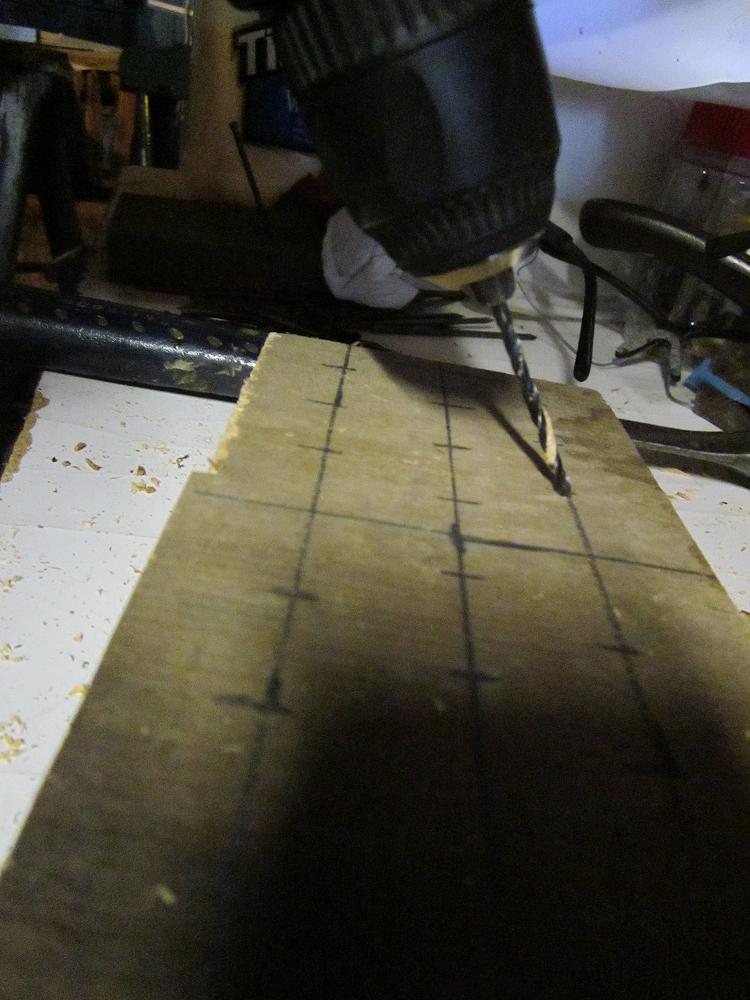
Mark out nail hole placement on 3 spike boards
I used 3 so that I could change the direction of the board, not the drill.


Drilling holes on an angle. 
If you want to be particular, use a guide.
(You can also drill straight, it works just as well)
Drill into another board so you get a clean back.

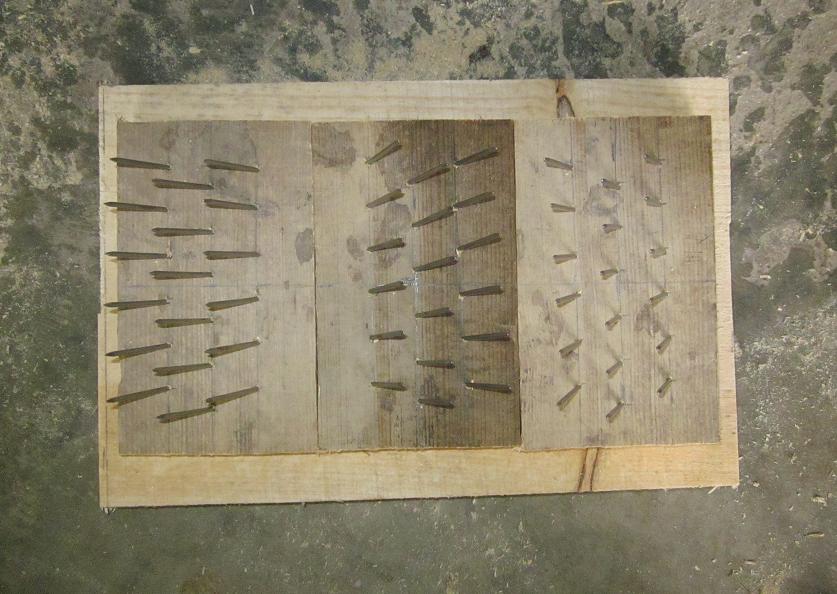
Nails in from the back, so the pointy bits come out the front.


Nails coming out the front.

3 spike boards finished (3 more to go for the handle)

Baseboard, spike boards & sides.
2 more "feeder" boards go on either side of the spikes,
mostly to have something to screw the sides into.

Closeup of the angled nails.
IN, Center, OUT

Feeder boards & Sides screwed on

3 more spike boards for the top and the top runner board.
Close-up of the top unit

Base unit & top in all their spiky scariness

Top & Base unit together

Into the Maw of the Dragon
(the nails are too close, I had to add more to keep them from scraping)

Do NOT put your hands in here.

Intake side.

More scary.
Now with 1/4" molding so the nails are not touching!

The finished wool picker
Detail of the handle
I could have done a much better job, but honestly, I was tired & it works.

Wool locks.
You'll need to hand-pick these apart &
remove anything you don't want mixed in with your final product.

First pass through the picker.

After 3 passes through the picker.
The Finn took 5 passes, so not everything is this easy.

The wool doesn't come out 100% clean, but the picker removes most of the VM.  As with any wool you want to spin or felt, throw out anything with 50% or more VM in it.  It's just not worth it & it'll wreck your yarn.
You have to use clean wool for this... no spinning in the grease if you want to use this machine.  The lanolin will make a mess of the nails, so only clean, dry wool, OK?
You also have to do a bit of prep work, just like you would with hand-picking, flicking, combing, carding, etc.  Break the locks up & start to break them apart a little.  Run it through 3-5x until it looks like it'll card well.  Discard any stubborn bits.  Dump the dust out every 3rd batch or so.  
I suggest filling up your intake box because the picker likes to have enough wool to grab onto... but don't pack it in because then it won't work.  It's simple, you'll figure it out.

This was MUCH faster than hand picking.  Not for every yarn type, but for a nice woolen with a stubborn fleece, it was about perfect.


To my knowledge, this is not a copyright design and no infringement is intended (certainly no profit was made).  It's a scrap wood project, that I hope will make my spinning life easier & please feel free to use this, or modify the machine to fit your own needs.

Tuesday, November 20, 2012

Emotionally Invested

This is going to be a little personal, but maybe more philosophical.

Today I got a FB "invite" to some Event on "why I should hate this blond lady for being a jerk at Arlington National Cemetery," or something like that.  Honestly, I didn't bother reading it, I just declined. 

The reason I declined was based on what I think of as Total Emotional Investment.  This is the amount of emotional energy that I have within myself to care about everything that I care about.  I care about many things, both real and conceptual; but in the last 2 years my focus has narrowed to the things that truly matter to me.  In the last 6 months it has narrowed even further, and I've had to give up caring about many things that were dear to me.


At the moment, my Emotional Reserve (the amount of energy I have which is set aside for random stuff) is rather low.  I'm tired.  I'm sad.  My blood pressure is screwed up.  (Cancer is gone!  Happy-face!)  But if it's not something that is directly impacting my life, I just don't have the uumph to put into it.  If it requires that I get angry, it needs to be worth me risking my life, or another stroke, or a heart attack, or at the very least another 3 days of Headache/Dizzy.

Some blond chick who has no manners or good sense?
Not worth a drop of my Emotional Reserve.

Some random obnoxious troll-chick who is horribly offended that I don't have the energy to care about some random rude stranger's 30 seconds of Rude Behavior immortalized in colored pixels?
So not my problem.


Before you scream at me, read on...

Yes, we have a sacred trust with the dead.  Culturally speaking, where we lay our dead to rest is sacred ground, and that should not be violated (never mind that it IS all the time, but that's another story).  It's why we are so horrified when punk-ass kids tip over tombstones.  It's why we are enraged when people steal bronze grave markers, especially from our veterans, our Honored Dead.  It's both a civil & moral crime that cuts to the heart of that sacred trust.  It's shameful.  It's disrespectful.  They are horrible people & deserve to go to jail for desecration.  Tombstones are also expensive.

But the dead don't care.
They don't care if a teenager tipped over their headstone or if it stands until time & rain wear it away.
They just don't.
If & when those trumpets sound, I promise they won't need a written reminder of their own name.


Those soldiers in Arlington... our great men & women who died fighting under our flag; they didn't hear her.
If by some strange twist of fate, some spirit or soul lingers there, I'm sure their shoulders are broad enough that they would not be wounded by the momentary actions of some vapid twit.
The people harmed here are the living; those who were there at the time grieving for their grandfathers, their lost loves, their brothers & sisters in arms. 

Now, who is served by hating this particular idiot on a social media site?
No one.
It certainly won't make her care or apologize.

What it will do is get a whole lot of people riled up about a person who will never change, and will likely brag to her friends that she got so many thousand people on FB pissed at her for less than 30 seconds of effort on her part.
She thoughtlessly made fun of a sign and showed her total lack of respect for that place and what it means to our nation.
That's it. 
Petty, yes.  Stupid, yup.  Disrespectful, oh yeah.
Worth my hate?  Nope.
She's not worth it.  You have to mean something to me to be worthy of my hatred.

Bandwagons have never exactly been my thing, and witch hunts even less.
Quite frankly, I just don't have the Emotional Reserve to be angry at that level of insensitivity & stupidity. 
If that makes me selfish, so be it.

I've already given both of these girls more than enough of my time; and yes, a few of my tears.


What I care about right this minute, right now in this week of Thanksgiving, is my family, my home, my job, this silly yellow waistcoat with ten million buttons, my cats, my friends - new, old, face-to-face and online, and I guess The Rosie Dog if I really have to.

I'm thankful that I'm alive, that my husband still loves me, that I'm recovering & improving every day, that the cancer is gone, that I'm warm, fed, loved... that I have people who I love.  I'm thankful that my boss can't fire me (haha).


I'm hopeful that we will have living children someday.  That I'll be able to drive again soon (without a babysitter), that things will go back to normal... that I'll find those IQ points I lost after surgery... maybe a few memories that I know are hiding in here somewhere...

My days are filled with sewing and cats, my parents & husband; spinning some days, photographs others.  A walk when I have the energy for it, history lessons when I don't.  (Rosie Dog, if I have to)...

Those things are simple and very personal.  They are also the truth.  It's what I have room for right now.

Saturday, November 3, 2012

How to Count Centuries

JMW Turner's "Stonehenge" was painted in the 19th c. (1828)


An important note on how to refer to the century you are talking about correctly:

Today's date is November 3, 2012. Which means we are in the 21st century.


If someone says "14th century" they are talking about the 1300's.
 

This is an easy concept once you understand how it works:
- The 1st century began in the year 1 AD (Anno Domini) /CE (common era). It ended in

the year 100 AD/CE.
- The 2nd century began in the year 101 AD/CE and ended in the year 200 AD/CE.
- The 3rd century began in the year 201 AD/CE and ended in the year 300 AD/CE

See how that works? You take the numerical date + 1 to get the century. 
Ex: "1776"  17 + 1 = 18... therefore "the year 1776 was in the 18th c."
 
 
Quick Reference for everyone:
1st century = 1-100 AD/CE
2nd c. = 101-200 AD/CE
3rd c. = 201-300 AD/CE
4th c. = 301-400 AD/CE
5th c. = 401-500 AD/CE
6th c. = 501-600 AD/CE
7th c. = 601-700 AD
8th c. = 701-800 AD
9th c. = 801-900 AD
10th c. = 901-1000 AD
11th c. = 1001-1100 AD
12th c. =  1101-1200 AD
13th c. = 1201-1300 AD
14th c. = 1301-1400 AD
15th c. = 1401-1500 AD
16th c. = 1501-1600 AD
17th c. = 1601-1700 AD
18th c. = 1701-1800 AD/CE
19th c. = 1801-1900 CE
20th c. = 1901-2000 CE
21st c. = 2001 - present... CE

Please, please, please... label your pictures correctly and when writing about and talking about a specific time frame, either "state the exact date" or "add one to the number." 
(If only to make my life easier when using Google Image Search.)

Friday, October 12, 2012

Making More Stuff

I wanted to do some lovely, witty blog post about all the stuff I've been making lately, but that's just not going to happen this morning.
So here are some pictures with short captions.  I may have posted some of these before, if so... sorry.

Roman Brachea (Breeches) for my friend Mr. Scott.
Super-simple Roman drawers.

Padded Gambeson for my husband (this is #2, which seems to be working as it should).
1-2-3 Fight!

Italian sleeves for Lisa (I didn't make the dress)
Sleevies!

18th c. stays from scrap fabric for Sam.
1715-60 Stays

1790-1820 outfits for the Delps
1790-1815 Waistcoat
1790-1810 Tailcoat

1805-1815 Dress
1805-1820 Pelisse
The dress & waistcoat were made this spring, the tailcoat & pelisse this fall.  Odd book-ends to my Medical Adventures, which are (hopefully) over.

There were a few other things that I can't seem to locate the jpg.s
I need to have a "finishing" day for a good number of garments that are >this< close to being done, but need accessories, buttons, hooks & eyes or hems. 

Monday, October 8, 2012

Purist

With a lot of care & work & changes
you might be able to make the McCall's into something worth the material going into it.
But probably not...


Yesterday at the Hartstone gathering (SCA) Vicki P. used a great word in reference to my "stickler for historic accuracy in all things clothing" - Purist.
I love it.
I admit, I'm not a Pure Purist.  I'm totally OK with machine sewing, modern interfacing for buttonholes, synthetic trim (when necessary) and even poly/cotton thread if Needs Must... Sometimes the design of the fabric is so very perfect, but the fiber content is a bit off, and that's OK as long as fire hazards aren't a concern.  Zip-ties for boning are A-OK with me, though I do prefer cane or reed or metal.

What I'm thinking about this morning is my personal approach when asked about historic clothes.  There, I'm a purist.
I will not give you an "incorrect" answer.  I will answer you to the best of my knowledge based on historic fact, my most current research & my best educated guess backed by that information.  I will also tell you which is guess & which is fact.
In form, function & outfit; the shape must be right, the layers must be correct and the fabric must have the proper weight & drape for the garment.

You must tell me specifics of where your persona is from.  I cannot help you if the answer is "in period" and "they traveled around."  It just doesn't work for me.  No offense to you, but you just fried my neural pathways & I have no direction to go in at all.  Tell me "French, merchant class, early 1600's" and I'm on it.  I'll give you the name of their tailor & let you know what kind of sheep they used to spin the cloth from, but don't try throwing Italy at me in the same breath.  If you want a versatile garment, tell me that.  Say "I want a generic Western European gown for the 1500's" and I can toss out a few that will work.

Patterns:
If the pattern is not available from a very reputable source,  backed up by historic information (archeology, museum pieces, literary sources, etc), it has to be a very educated guess, following the proper form, for me to say "yes, go for it."  Please, present your research to me.
I won't just say "yes."  I'm not a Yes Girl.
Please, do not hand me Simplicity or McCalls, though they can be decent when cross-referenced with real research. I know a lady who makes patterns for McCalls & she is Spot On... but she's one lady who occasionally makes patterns for that company, and they hire a lot of people who are not as careful.
When you ask me, you are going to get Janet Arnold, Norah Waugh, Linda Baumgartner, and a host of other serious scholars who have backed up their patterns/research with original garments & primary sources.  You'll also get Diderot, Gersault & Le Art du Tailor.
From there we can talk about adjusting to fit an individual portrayal; within your budget - but that's where I start.  Accurate.

Good questions to ask are:
- What garments do I need to make for this portrayal?
- Will I be comfortable in this outfit?
- What weather will this outfit/garment be suitable for?
- Can/must I combine it with other garments? (Is it versatile?  Is it a one-trick pony?)
- Would my persona have worn this or am I just making it because it's nifty?  (it is totally OK to build a persona off of a costume vs. making costumes to fit a persona; however you want to do it is fine).

Fibers & Materials:
I truly believe that using natural fibers - linen, wool, silk, cotton or a combination thereof - is the best course of action.  Care is straightforward, the garment will last for years, fire hazards are reduced to a minimum, natural fibers are more comfortable, and above all it's correct.  You can wear natural fibers to any event without worrying about looking out of place.  You don't have to gaze longingly at your pretty polyester petticoat & sigh because you can't wear it to this Uber-Accurate Event that it would otherwise be lovely for.  When it gets stained you can just throw it in the dye pot & it will take the dye evenly unlike synthetic or synthetic blends.  You can even dye it with natural dyes!
Using the appropriate weight fabric is also very important.  If you can watch t-v through it, chances are it won't make a good winter coat - but it might be perfect for a gauzy cuff or floaty dress.  Cheap cotton is just not going to cut it for a structured gown, where a nice linen, wool or silk would be perfect... even a heavier weight cotton can be lovely.

Good questions to ask & answer are:
- What fabric(s) was the original garment made from and why?
- Did it have structure built inside, or is it a soft garment?
- Was it made to go over a structured garment, or is it supposed to be worn on a natural form?
- What materials/accessories am I going to need to make this garment & how many yds. will it take?

Cost:
Yes, fabric costs money.  Period.
It will cost a lot more money if you just throw "whatever" together & have to do it again later if you decide that you really do care & want to stay in the hobby.
It will cost a lot more money if you try to make the wrong fabric work by plastering $200 in trim over it when you could have just spent $40 more on the right stuff.
It will cost a boatload more if you use a crappy synthetic that shreds & blows out the first time you wash it, or a $1/yd cotton for an outer garment that should be relegated to flat-lining for quilts or making muslin mock-ups.
Personally, I think it's best to care to begin with... that way even if you decide that you don't want to continue in the hobby, you can turn a few dollars on your old garb vs. having to toss it in the Halloween Donation bin at the local Good Will - though that's not a bad idea... better than handing it off to some poor newbie when you know for a fact it's totally incorrect.

Good questions to ask are:
What is my budget for this outfit?
Where can I obtain the correct fabrics for this outfit?
What can/can't I skimp on?
What is necessary & what can be left off until later?
How will this fabric preform? (Will it be hot/cold/damp/comfortable etc.?  Will it shrink in the wash?  Will the combination of fabrics play well together?)


So basically, when you ask a clothing history geek "What should I wear?" don't be surprised if we won't compromise on honesty.
When you ask a Purist "can I use this (ghastly) polyester (modern) print?" and we say "um, no." don't get upset.
By all means, make costumes.  Costumes are cool.
Us Stitch Counters/Purists understand that not everybody cares about what we care about.  But if you ask us for help, and then say "well, I wanna do this totally farby thing anyway" don't take the ))Face/Palm(( wrong - you just asked, we just told you... we can't make you be accurate... but if you weren't planning on it, why did you ask in the first place?  Though we do want you to ask... please ask!
Just like we are going to ask about those fantastic apple tarts...


We aren't Perfect Purists, we know that.  Research continues, improvement is the goal... And I can almost guarantee we've got Pop-Tarts in our food box...