Wednesday, July 4, 2012

Solar Dehydrator for Dyestuffs (or whatever)

It Dries!
It Dries Dyes!
A while back my electric dehydrator decided to fizzle out.  The fan stopped working, so while it goes round & round, nothing is happening.  On the 3rd day of trying to dry some sage, rosemary & cilantro (food), I about had a screaming fit & just shoved everything in paper bags to finish drying. 
Around that same time I saw a FB post of the prettiest garden box ever... turned out to be a solar food dehydrator.  Massively cool.

At that point, I decided that low-tech is better & as the "sun produces enough energy in one day to power America for a year," or some such like that, Solar it is!

I looked up various versions of a solar food dehydrator & decided to go with one I could build & move, and store inside when not in use... and one that I could make from materials on hand.  The one I ended up building is similar to this
http://www.territorialseed.com/product/13577/online_specials
except not nearly as pretty & it sits on a table, not on legs (see above).  Also, no nifty temp gauge. 
If you don't like this design, or don't want to pay that much for one, just go to Google Image Search & type in "how to make a solar food dehydrator" and about a million plans will pop right up, from super-fancy to cardboard box versions. 
There is a pdf. instruction guide that I saved but can't find again "dehydrator guide with photos" and "dehydrator plans" that is really decent.

I did make the door open up vs. dropping down because while I like the shelf idea, it was just too big to be able to reach the front of the dehydrator without some serious gymnastics... and we all know stuff is going to fall at some point.  A hook & eye safety latch will take care of the "crush your head" issue.

Materials:
Purchased:
$5 Garden plastic for my "black" bits & about $7 on hardware (screws, staples, hinges) for a total of $12 in purchased materials... I may have to calk the cracks for more efficient airflow, which would bring the cost up to around $15.
Re-used:
I used scrap wood on hand, bits left over from when my parents built the addition on the house, scrap lumber that was too short for other things or too knotty for structural projects & an old window that I /think/ came out of the laundry room that they tore down years ago.  The frame is in terrible shape on the outer edges, & the glass is cracked in one place... but for this, it'll work.  I used some old metal shelves that came from ??? for my drying racks & I can put gauze or smaller mesh screen or whatever over them as needed.  Paint was left over from the addition, (which still needs more paint in places).

Since I'm using it to dry dyestuffs, not food, the food safety aspect wasn't a huge issue for me.  I was able to skimp on the food grade screens & I didn't worry about the low VOC plastics or paints.  If I ever do want to dry food, I can always switch out the screens & find different plastic (it's just stapled in).  The paint should be fine after a few weeks anyway, but please do your research if you are going to use this for food; we get enough toxins from commercial food - no point adding them to your home-grown stuff.

The basic principle of the dehydrator is that the air comes in the bottom front opening (screened over), flows up through the airspace & exits the rear top opening (screened over).  The window lets light in to provide the means of heat (sunlight).  The black in the bottom & back wall heats the air as it goes through.  It's very much like a car in a parking lot. 
You can control how much heat & light get in by turning the box toward or away from the sun, and blocking off airflow, or covering some of the black with white cloth, etc. 

While I'm not sure how long some things will take to dry, it does work quite well.  My sage was dry in 2 days & so were the day lilies that I'm collecting for orange dye.  The Queen Ann's Lace seems to be taking a bit longer, which is interesting, if nothing else.

It does have to be taken inside when it's raining as it will wear out quickly if left out in the weather.  You could potentially make a weather-proof cover for it, like the ones they have for gas grills, but personally, I'd rather just bring it in.  In theory, you could use it in a window in the wintertime.

Should be loads of fun, and it's already proving useful.  I don't have to worry so much about things molding or getting rained on if a little sprinkle comes along, or the cats spraying on my dyestuffs (yuck), or a million other problems that come with open-air solar drying.


Tuesday, July 3, 2012

Random-Medievalness in Gail-Land


1180's outfits.

I have been a very bad girl & not posted anything lately.  THINGS have been happening in my personal life that have made me throw a few other things by the wayside.  Fortunately, Things are getting straightened out after much to-do and sadness & we are nearing a resolution to the Issues. So, in light of this grand personal news, I now have a few topics to happily ramble on about!

Like... some of what I've been working on!

John & I decided to try Medieval Stuff.  Lots of fun being the Newbie! 

My Quest for Bust Support will eventually lead me into the 1400's & 1500's, because the 1100's are sadly lacking in that department, though not for lack of trying on my part.  I also like mid-plague society infinitely better than late Dark Ages, for whatever reason.  John prefers the men's fashions to the whole legging/hoes tied-to-the-belt situation. (Wait till he finds out he has to wear a codpiece with those fab jerkins).

Mirror, Mirror On the Wall,
When's the last time someone
used Windex on you?
The first try at Lift was this creative-canvas job.  It's built off of my 1820's stays, which is the equivalent of a body block, and once clothes are over it, it does a decent job of costuming me up like a Chartres Cathedral Matron... one of the fatter ones, if there is such a thing.  NOT a time frame that flatters my natural form.  No evidence of bones used at this time, so it's a total Creation in the best & worst sense of the word.

It's OK.  It works.  It'll also work for 1820's & 30's if necessary.


1180's Pink Thing
You can see how terribly unflattering this  pink cote is on me... After seeing these pics I changed things up a bit.  I made the other cotes side lacing, gave them a bit more shape, tried not to look like Girl In Sack Attacked By Strawberry Ice Cream Smoothie Machine.

It's hand-finished so I'll have to pick out my lovely stitching to turn this into something worth wearing.  I did make 2 others, one in burnt orange with white facings & one in a lovely brown linen that requires a belt so as not to trip me up.  Both are infinitely more flattering than this, but I am lacking pictures... our first event was Celtic Fire Festival, and we were Kitchen Help.  We forgot to "smile for the camera" until we were driving home, then it was too late.

I'm so terribly thrilled with it, can't you tell?
The second try for Bust Support was this lovely construction, made after the Bath House Babes of 1380... controversial, yes.  Ask my chest if I care.
Again, based off of my 1820's stays for sizing, but simplified to front & back blocks, with triangular gores in the sides & one in the bust.  Adjustable shoulder straps that have since been adjusted farther "up."
No boning, just cording, which does the job fine.  Again, no historic evidence to support this manner of support, but as it supports me quite well, I'll swallow a bit of anachronism in my historic cocktail.

It does sit straight once it has time to "relax" onto my body, and my posture isn't usually so terrible.  Must have been One of Those Days.  Horrid picture of me... why am I posting it?  Oh what I do for costumes!

1380's Bath House Babe Rendition
Here is a lovely close-up of the sides.  After talking with Charlotte, she suggests the next one I make be tight only to 2" under the bust, do a full fitted shoulder strap & neckline, and it should give me both the lift & comfort I want without the need of cording.  I think her theory is sound, we'll see if my Upper Regions agree.

It lasts for about a day & 1/2.  Then the linen & hemp start to sag around mid-day of the 2nd wear, so I'd need several of these supports for a long camp.  (Yes, I'm allergic to hemp, but it's totally encased in linen & this will NEVER touch my skin, so I think I'm safe).


SHOES!
The shoes!  Ah, turn-shoes, how I love/loathe thee!
I love how they "turn out" (ha)!, but making them is a total pain.
I tried it on some lasts, and it helped a little, but I ended up just stitching them & then flipping them right side out... which takes more time & effort than is pretty, and requires closed eyes to magically accomplish. 
(BTW, this is what happens to my ankles after eating a doughnut.  Doughnuts are BAD, do not eat doughnuts.  Doughnuts have barley, and barley is BAD.  My wrists were not quite as bad as this, but it was still awful).
Anyway, the toes have some issues, which I'm slowly learning to resolve.  I've also learned how to put a welt in between so I can glue & stitch a harder sole to the bottoms.


Thus ends my Medieval adventures for the time being. 

I've moved on to 1800's to try to finish up my remaining orders before I'm down from surgery.  We all know that'll never happen in time, but I think I can get the main ones out of the way before it's Time To Stare At The Ceiling  again.

Edit
8/17/12:
Please go read this.....
http://www.historyextra.com/lingerie 

Friday, June 1, 2012

American Duchess "Yay"!

They Are HERE!!!
I just ordered the Pompadour shoes from Lauren & am quite excited to see them. 
So, today is the last day for pre-order on these darlings.  Just so you know.  The good news for all of us is that they are going to be produced as a line because her pre-order requirement got filled.  Yay!

http://www.american-duchess.com/shoes-18th-century

I got the Georgianas when they first came out, and they've held up quite well.  I still haven't decided on a dye color for them, and I've gone & ordered another white pair of shoes (groan)... but the blacks just didn't thrill me quite as much as the prospect of being able to make them look like the to-dye-for (ha) V&A shoes below.


The shoes are very good quality & a very good price.  Honestly, I'm planning on wearing these quite a bit & not just at historic events.

I'm afraid, for a girl who spends most of her life barefoot & has gone years with exactly 2 pairs of every-day shoes, I'm becoming a bit of a shoe-horse when it comes to historic shoes.

Friday, May 25, 2012

1880-1910? Walking Dress?


I was just gifted another lovely antique dress, and I honestly have no idea what the exact date of it could be.  Best guess is 1880-1910.

The dress has no accompanying information, other than "the Ashville, MA Historic Society didn't want this," and I'm more than delighted to have it!  Again, thank you Suzi!

The silk lining on the front of the jacket is in shreds, but I believe I can stabilize it without too much difficulty.  The top of the skirt is another matter.  I hesitate to even consider touching it, it's in such bad condition.  The bottom of the skirt is in perfect condition; unless you count a bit of drag-dirt as damage & some busted pick-up ties.
(skirt is a stock petticoat that just matched in color, not part of the original outfit!)

This is the front piece, it closes with 5 hooks & eyes at the back of the neck & then fastens on to the front by hooks & loops at the sides.  One side of the bottom front has been either taken out or torn out.  The original folds are still easily visible.


The embroidery is really quite striking & very Art Nouveau. 

It is in excellent condition, no picks, no runs, no damage of any kind.  The satin is in excellent condition.


The sleeves are absolutely lovely, and one of the things that makes me think "walking dress" over Day Dress or any other kind of gown.  It could also be a traveling dress, but as I don't know enough about this era, I really can't say.  Please don't take my word as golden, I'm out of my depth here. 

The right sleeve does have a couple blow-out places along the elbow,  but otherwise both sleeves are in excellent condition, including the underarm areas, both inside & out (amazing, really).


The back of this bodice is striking, and has a multitude of pin-tuck pleats.  I'm really thrilled with how charming the back is.

The entire garment is machine sewn, with a few hand-finished areas, like hooks & eyes.

I have (had) not photographed the skirt on a dummy because the silk is in terrible condition.  The waistband is completely shot and may not be repairable (but is a replacement!  Yay!).  The upper portion of the skirt is blown out in many vertical splits which are repairable with care. 

I believe that the silk was treated with some metallic solution to make it heavier, which was a common practice in the late 1800's & early 1900's, but that makes the silk very, very fragile. 


Suzi & I did put the skirt on one of her dummies, and at that point, I readjusted my estimate of 1910's back to a possible 1880's or mid-1890's.  The skirt appears to be a bell shape, but one that would go over a fairly large bustle & may have had an overskirt to match.  This may not be the case, and I will have to examine it a little more before I reach any definitive conclusions.

 It does have a wonderful silk bow that has frayed in it's tied state, and will remain so for as long as I own it.


I have very little experience with restoration, and so I'm not going to be diving into this project with any kind of urgency.  It's lasted this long, it can wait a few more years until I can either pay a professional or gain the skill necessary to save whatever can be saved. (Yes, it came in a garbage bag - much as all good "finds" do).

Ultimately, I will be making a pattern based off of this outfit, but for now it will get packed away in a nice, acid free box with tissue paper to help protect it.

Here it is just pinned on, but you can get the general idea of what the whole outfit looks like.


I laid the skirt flat so I could see what the general shape is, and it's a bell with a shorter front & longer back, cut in triangular gores, which probably have curved seams (but I haven't measured yet).  The wool is appliqued on & tucked up, and the bottom is quite stable. 

Here you can see the inside, which is interesting in itself.  I like the reinforcement areas of the black linen for the upper decoration.

Tuesday, April 10, 2012

18th c. American Women's "Jackets"

The question of late 18th c. women's jackets has come up on several blogs & discussions, and rather than Over-Post my findings in their comment sections, I'll post them here.

The results of my search are murky & not as overwhelmingly positive as I'd like, but I think we have a definitive "yes, jackets were worn in America" if we properly define "jacket."

A "jacket," by my definition (and backed by several written sources) is similar to "sweater" in terms of the broad use of the word.
Ex:
a sweater can be a
pullover,
cable knit,
cardigan,
vest,
v-neck,
turtleneck, etc.
Just as a jacket can be a
shortgown,
bedgown,
or even occasionally, pet-en-l-aire
waistcoat, (what reenactors improperly call a "bodice")
Brunswick style (with it's 12 names, but Irish Hood seems to be the preferred NY tag),
caraco (which just means "jacket", please stop calling it a "caraco jacket", but it is a specific cut)

BUT, for just a moment, I'm looking specifically for the jacket that Hallie Larkin of At the Sign of the Golden Scissors is talking about, which is a fitted back garment with front closure (either stomacher or straight) and skirts (either attached or separate seam) to no lower than mid-thigh level. If you aren't familiar with her blog, go read it. She is conservative in her research & refreshingly picky with her terms. (if you haven't figured it out, I'm a generalist).


I've found several written references to women wearing jackets, and a one example of an imported jacket that was owned by an American woman.

"Miss Patty Parsons, cut up the embroidered sky blue satin waistcoat which had been worn by her grandfather at the English court, and who fashioned therefrom a "jockey" which was deemed "wondrous becoming." 1775, America (probably Philadelphia)
"A troopers scarlet coat was made into a beautiful jacket for a fair girl, and from the little pieces cut from the coat-tails, lapels, etc, were fashioned a perfectly fitting pair of warm winter gloves, bound with gray squirrel fur which also furnished a collar and cuffs for the jacket." 1775, America.

However, most seem to be what we would otherwise call shortgowns, bedgowns, and other informal style "jackets." Names mean quite a bit if you can pin them down.

In the Virgin Islands, you can see the widespread use of the shortgown/waistcoat/jacket as the working woman's outfit. No, it's not continental America, but the Virginia slaves & white working class seem to wear almost the same things.
http://www.lennoxhonychurch.com/brunias.cfm

Here are some slave advertisements describing clothing worn when they ran away. I would call the illustration a shortgown or waistcoat, but it also has the very wide neckline & tabs or skirts of a working class "jacket," (illustration).
Outfits of matching fabrics, even if they are a petticoat & top are occasionally called gowns, though in this instance I think it's probably a genuine gown (written).
http://www.accessible-archives.com/2011/05/10-southern-us-slave-advertisements/

It is highly unlikely that we have many working-class jackets, as very few would have survived. The Pennsylvania shortgown survives as it was so prevalent through that area. There is a little debate about how widespread that style was, but there are enough records to support it's use through New England & the Middle Colonies. This particular "jacket" or shortgown was considered quite ugly by recent English immigrants, they were shapeless, often made of homespun & were said to be a single layer of fabric (so the quote says, though surviving examples are often reversible being made of 2 imported printed cottons).

There is a silk Spittalfields jacket of 1780 in rather poor condition (with provenance) that belonged to a woman in VT. Unfortunately I did not note the source of the image, I believe it was an auction site (Vintage Textile?), but it could have been Boston Museum of Art? I kick my years-ago self for not keeping better image records.

The Met has this jacket, which I would call a bedgown, listed as American or European - not definitive. The fabric is most likely European, but the garment assembly could be either.
http://www.metmuseum.org/collections/search-the-collections/80036043?img=0
When the museum doesn't know, causal researchers are in a hopeless bind.

It's important to remember that many people ordered the latest fashions from Europe, and that many competent seamstresses & tailors here re-created those styles. So it's plausible that English (Spittalfields) jackets were worn in our major urban hubs, and that many French fashions were also brought over. "A gown in the latest fashion" and "A suit in the latest fashion" are very common clothing order phrases. Also, to save money, people would often order a pre-cut, but un-sewn garment "to be made up."

I do think it's important to recognize that very few of the surviving examples of fancier jackets in the French & English style have American roots. The one above is the only example I've ever found that was definitely worn by an American woman, in America - though it was imported from England.
It's also important to remember that immigration has never stopped. People (women especially) did not just dump all their possessions in the Thames & arrive here in the Colonies with nothing but a shift on their backs. Trade, goods, people & their belongings & styles went back & forth across The Pond on a regular basis. Not everyone traveled, and not all the time, but we have enough evidence that we know America did not exist in a fashion vacuum.

This is not to say that I want to see hundreds of silk embroidered fancy jackets at every reenactment from Quebec to St. Croix. Research your fabrics, region, cut of the "jacket", station in life & other assorted necessities. But please don't hesitate to buy a good quality jacket/shortgown/waistcoat/caraco/Irish hood from vendors, or buy a pattern to make your own - as far as I can tell, they are correct for the Colonies and (in some cases) early America.

Saturday, March 10, 2012

1900-1918 Wedding Dress

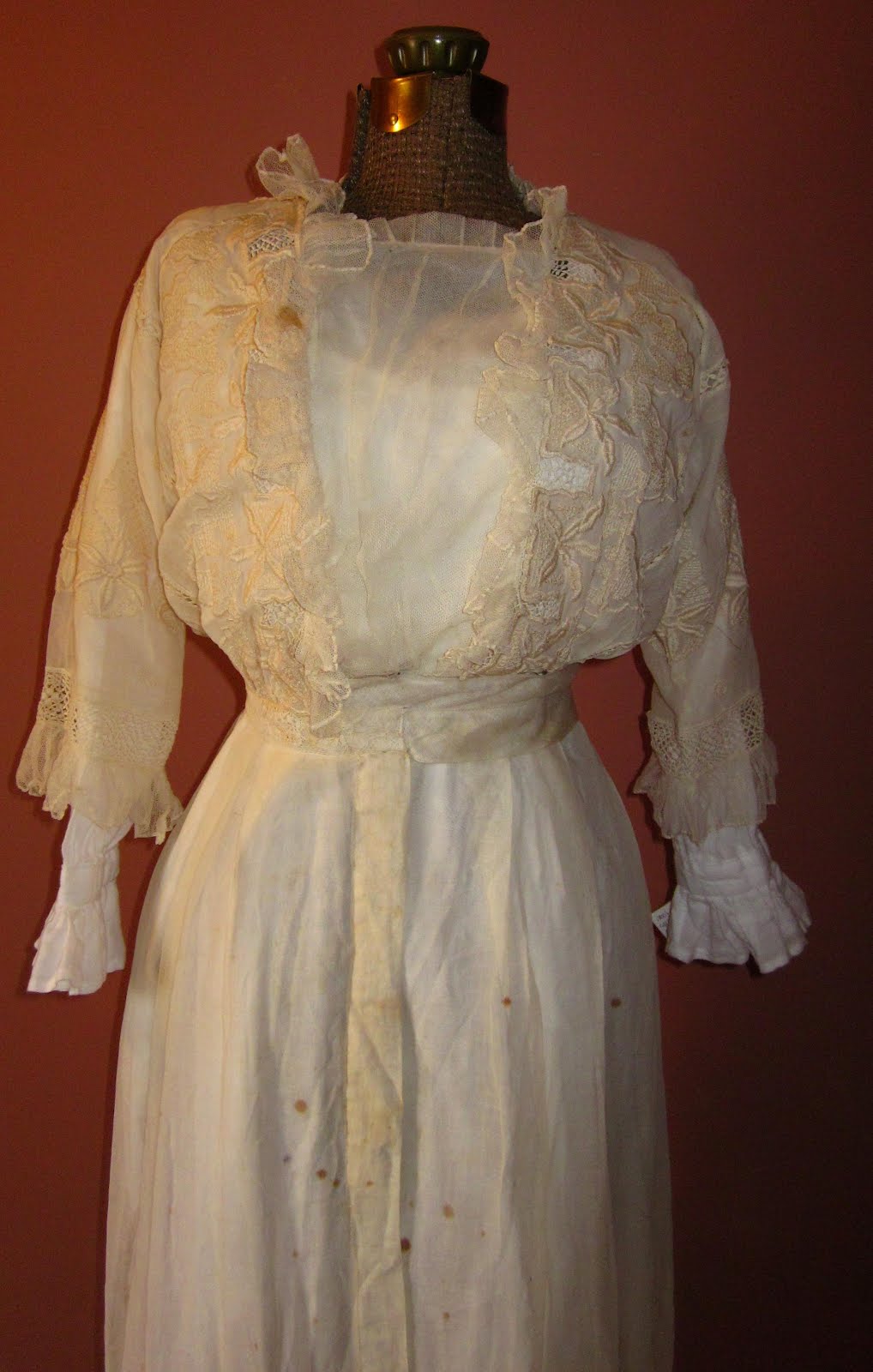
This is a 1900-1918 wedding gown that I own. It was gifted to me by a friend many years ago & I've finally gotten around to photographing it.


The family story was that Grandma Bernice "Burnie" was married in this dress, in Australia - I believe just outside of Perth. 1908 is sticking in my head, but I just don't remember. She was a rancher and a rancher's wife, of small stature & slight figure, very wiry & tough. She lived to a ripe old age, had 7 children, and her wedding gown made it to America with one of her daughters, who's daughter then gave it to me because "you'll like it, it's just trash to me."
It's true that one woman's trash is another woman's treasure.


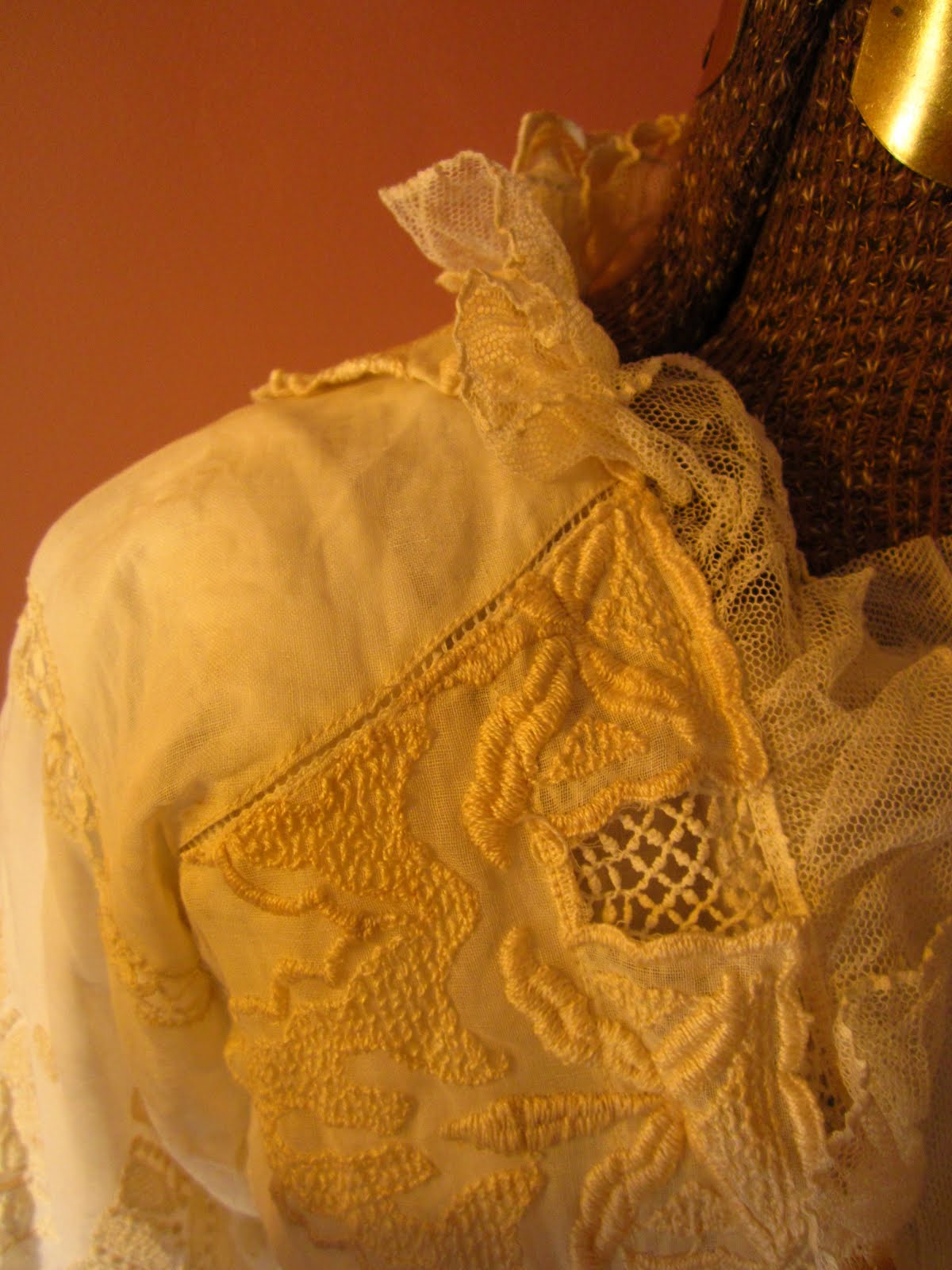
The dress is in near perfect condition. It is all machine sewn, and is made of early machine lace, netting & lightweight linen. It has some age stains on the front & is missing 3 snaps on the center back for the belt.
It fastens down the right side front with snaps & the belt wraps to the left with snaps.
The waist measures 22" when closed.
(pictured over one of my stock chemises)


It is not a rich woman's gown by any means, but is a lovely example of a working woman's wedding dress.


Now that I've shared it with you, I'm putting it back in it's box.

Friday, March 9, 2012

How to Phrase the Buckskin Dress Question?

Last week I received an e-mail from a (potential?/not?) customer that was innocuous enough until today. What brought this to the forefront was seeing a stunning leather dress made by a new FB friend, and talking with a different customer about the very same issue, which made me remember all the other women who have gotten dragged out of my store by their guys because "it's not a leather dress," and before you say, "it can't be that many, Gail" trust me - it's a lot... If as many girls that get told to wear leather wore it, we'd see a lot more girls wearing it.
It's bothering me enough to put the situation & question to you, Dear Readers.

Note: I'm not taking any orders right now, so unless she's buying something I have in stock it's not an issue for me, and I don't make leather dresses anyway - so it's just a matter of who I send her on to. But how/who to send her to?

Situation: She is very interested in getting into living history/rendezvous/Rev War, and her husband has been in it for quite some time.
Issue: She wants to dress Colonial, he wants her to wear a leather dress (no indication of tribe/nation or time frame, and she says he dresses Skinner).

First: I'm not a fan of buckskin dresses. When done well, they are stunning - when done poorly, well...
I don't like wearing them - they are cold & damp when it's cold, hot & sticky when it's hot, they make funny noises when I walk; they chafe, rub & pull; they stay wet once they get wet and they smell funny. They leave little flecks of leather-sweat-slime all over me. I'm self-conscious about my hips and they showcase my worst attributes at all times, and I can't stand to wear a bra with the dress, but I'm physically uncomfortable going without. Let's not even discuss keeping all that fringe away from porta-potty water (OK, fine, it's similar to the paniers in the pee-bucket issue -- those things are just not made for pre-20th c. women)...
Overall I'm just not a fan. So it's really hard for me to play them up to anyone... though when they are done well they are stunning.

Second: I'm just stubborn enough to be irritated at one person telling another person what to wear, especially when the person doing the telling isn't the one doing the buying/selling. A gift is one thing, "because I said so" is a whole other ball of barbed wire.
Having duly noted the irony of the above statement (I'm in the business of telling people what to wear) and acknowledging that personality quirk; I'm not in the business of causing marital discord.
BUT... there are high points to buckskin dresses, namely "when done well, they are stunning."

Thinking about this issue, while sewing a lovely (yes, please turn out lovely) 1800-15 bib-front dress, I came to the conclusion that the symbolism associated with the Buckskin Dress can go one of two ways while our guy is holding up a smoky, dirty, clingy, sack-looking thing & smiling at us like a mad-man, while we're trying to read his mind (which we are terrible at, FYI) . He's either thinking...
1: You are my Sun, Moon & Stars; my one and only love, Treasure of my Heart and I want you to be my Indian Princess.
2: Burn this hunk of meat on a stick, Squaw.*
*1927-1993 definition - ick.
It could go either way, really. And us girls who aren't huge leather fans are always wondering if it's #2. There's a big difference between being your Lady Love and being your Old Lady.

In reenacting terms, a good portrayal is priceless.
OK, so you want me to wear a buckskin dress. Why? Who, when & what am I representing? What are the proper mannerisms, lodging, food, hairstyles and furnishings? What is the history of the people I'm representing? What special skills did they know? Are their descendants still around or have they died out/integrated? What goods were traded/produced by those people and with whom? Who were their allies/enemies? What is a plausible back story for this specific portrayal and at what types of events will I be portraying her and to what extent? You're not going to try to talk me into getting a facial tattoo, are you? I mean, you do know that's what eyeliner is for, right?

Is a buckskin dress the goal, and should we therefore build the character around the dress? (totally acceptable).
Or should we research & build the character first, then represent her faithfully even if she would have worn a linen shortgown & wrap skirt & wool leggings?

I could say more about humorously bad experiences with wet leather, but anyone who has ever worn a buckskin dress in a 40F rainstorm Knows.
I will say, buckskin dresses are remarkably easy to swim across a river in. Do not try that in Colonial clothes.
Link

So I guess I have two questions:
1: Ladies, if you love/hate leather dresses - why?
2: Gents, if you love/hate leather dresses - why?

Gorgeous! Stunning! "This is how you do it!"
http://www.nationalcowboymuseum.org/research/cms/Exhibits/PhotographsbyGeorgeAAddison/tabid/410/Default.aspx

Umm.... notsomuch unless it's Halloween; then go for it... but not at a reenactment, please.
http://www.webnuggetz.com/indian-halloween-costumes-for-women/