
Thursday, September 5, 2013

Tuesday, August 20, 2013
Kid House
 |
| Yup, I'm a kid-house. |
While this pregnancy hasn't been a piece of cake, it hasn't been totally horrible either. At this point we have a very reasonable expectation of a living child.
I spent most of the first trimester on partial bedrest. We were so afraid of losing another one, it was worth tracing the tiny cracks in the plaster of my bedroom ceiling over & over & over & over & over again.
The second trimester was like "wee! energy!" tempered with "Don't Lift THAT!!!" I was able to go for walks, sew a little bit and regained a touch of normal life.
Third trimester has been up & down. Bed rest again for a bit, followed by some minor prego issues & borderline test results. Nothing to indicate an unhealthy pregnancy, but things that do need to be managed. When I push myself is when I get into trouble. So no pushing. I've been assured that we really are healthy, but I won't downplay the paranoia.
Mommy Brain is absolutely horrid. I couldn't sew if I wanted to... it's as bad as being drunk, though not quite as bad as it was after the mini-stroke of last year. The boy will be getting a lot of reenacting clothes with crooked seams & bad hems. Somehow I doubt he'll notice or care. I've sewn the wrong things together, linings to outsides, squiggly seams, cut original patterns vs. tracing over & making new ones, misaligned things, and a whole host of other bone-headed mistakes. I'm told this will pass rather quickly & I'll look back on it with humor. I certainly hope so. I swear they steal a bit of our brains to make their own.
Upcoming Projects
All of this means that the business is closed for the next few months. Tentatively we will re-open in February or March depending on how things go. Once I can wrestle dummies around & take pictures of all the "new" stock that I never uploaded onto the old website, we'll have the new website up and running. Though we haven't been taking custom orders for a while, when the new website goes up it will be purely off-the-rack.
Please feel free to call or e-mail and ask about what we do have in stock, but don't ask me to sew anything! We'll both regret it!
Tentative plans are to attend Ft. Frederick in the spring, either as a vendor or as a camper. This will entirely depend on how the boy & I are doing and if I have an assistant, and if they let me in after I skipped out on them this year (see First Trimester Coma).
Between now & then, I'm focusing on research (ha! try that with Mommy Brain!) via photocopies, highlighters & notes in the margins. Once I have my head on straight will any of it make sense?
 - The main project is a timeline of patterns with research summary going from 1000 to 1500 for men & women in S/M/L. These are outfits, not just one-off garments, and they all require fittings. I will post the research & some pictures either here make a new blog specifically for this project and link to it. It's an SCA thing and I have no intention of publishing or marketing the patterns. Right now I have 4 outfits done, 6 to go. I won't do much until I can actually sew things together to check how the patterns work, but I'm not in a rush to finish it.

- Moving the store out to the stone building (which is still dirt floors & broken windows) is on the back burner. It must be done because the child will need his own room soonish, but there is a lot of heavy lifting involved that I'm simply unable to do right now. I would like to have the floor poured before it gets cold, we'll see if that's possible or not.


I got better at making them as time went on... this one - not so good. It'll catch poo, but it's kinda ugly.
Thursday, July 4, 2013
Real Models
Sometimes in costume design you have to sketch things out for a client or yourself before beginning a project. The typical fashion design template is going to be something along these lines: http://defnotez.deviantart.com/art/Design-Template-female-166911755, which is fine if you are actually working in the fashion industry or marketing your designs to a corporation or manufacturer.
Unlike mainstream clothing design, historic costuming is a whole other ballgame. First, no human being in the world has legs that are 6 heads long. Most women range from 5-8 heads tall total, not 9 or 10 (or 12) like the Barbie-esque fashion industry would have us believe. The average woman, American or not, has a much higher BMI than these ultra-thin sketches would have us believe; so to get a realistic idea of what my clients are going to look like in a given outfit, I go straight for the camera & photo editing programs, print the master copy out & go to town designing over their "real" bodies.
The first set is from my own wedding dress designs using various patterns & fashion plates that I stretched to fit my own body in MS Paint. I think these were from 2006 and it was the first time I used this technique. Since it was my wedding, not a reenactment, I mixed a lot of time period elements.

First I start with the body blanks (now I take front/side/back)
Take the photos from the mid-level of the body to avoid foreshortening.
Edit out the background for a clean white copy.
I also trim off things like t-shirt sleeves & other clothing bits that hang out beyond the form. Skirts usually aren't an issue for me but if they don't fit your design have your model wear pants so you can see their legs.


This is the design I ended up going with. The patterns were purchased from Truly Victorian with a few minor modifications.
BTW, Heather's patterns are awesome.
I fiddled with a few other cuts & time frames, but really liked the Monet's Picnic theme, so we stuck with the 1860's fantasy dresses.


You get the idea... same commercial sketches, slight variations in how I stretched the images to make them fit my own body. It let me see what a 150" hoop looked like vs. a 100" hoop. I also got to play with colors, though I knew I was going with red after having weeks of White Dress Nightmares.

 We made a trial dress to get the idea of the shape (bodice not fitted here) and then went on to make the final outfit.
I changed a few things as we went, rounding out the hoop, shortening the skirt, the neckline & waistline shapes changed a bit.
If I had it to do over again (please, no more weddings), I would pick a different cut for the neckline & take more care in fitting the shoulders, but these are the things we learn in time.
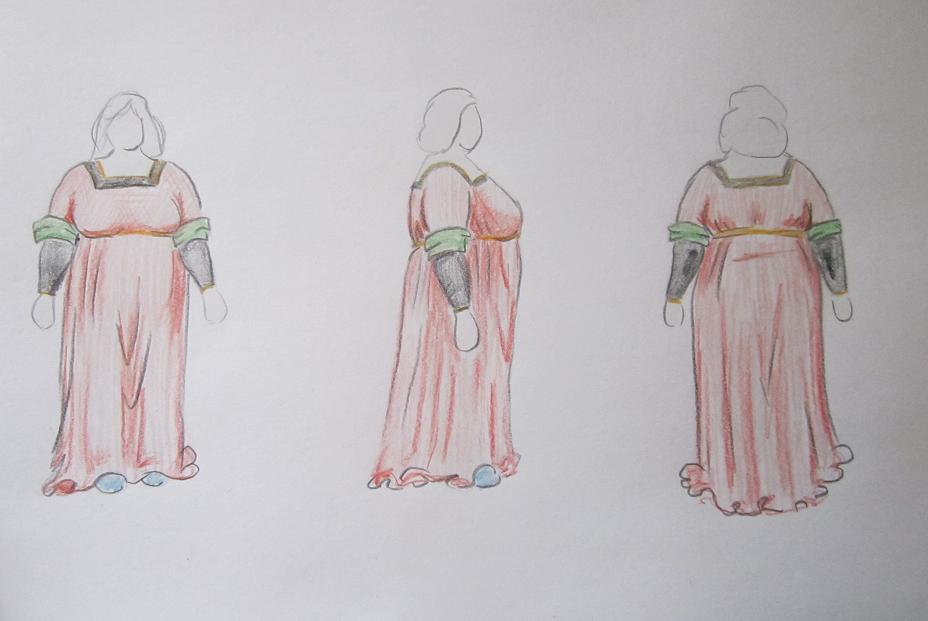
Today I prefer to use a print-out master copy of the front/side/back photo & draw the designs with colored pencil. This is especially helpful when a customer doesn't know quite what they want.
Below are recent sketches for Vicki's gowns from various time periods & locations across Europe.
This lets me plan an outfit from the skin out, listing the necessary garments & any important facts that go with them.
Hand drawn is faster than digital and I can easily explore slight design changes without cursing my mouse.
Hand drawn is faster than digital and I can easily explore slight design changes without cursing my mouse.
 |
| 1430's Vander Weyden dress |
 |
| 1500 Italy, St. Catherine of Alexandria dress |
 |
| 1530's Anne Stafford dress |
 |
| 1580 Ball of Henry III dress |
Monday, May 20, 2013
1860's Bonnet Construction

WARNING: I may not have done this correctly and I am not a professional milliner in any way. I also highly recommend spending the money to buy this item from a professional. Very much worth it. Every penny.
Note: this is not my pattern. Anna Bauersmith traced it off for me & sent me directions for a drawn bonnet (which I did not do due to a lack of fabric - not kidding, I had exactly enough silk to do what you see here). You can see her blog here: http://annaworden.wordpress.com/
And her Etsy store here: http://www.etsy.com/people/AnnaWordenBauersmith?ref=si_pr go buy something from her, she's fabulous.
1860 is not exactly a decade I visit very often, but there are many Civil War events that I want to walk into & visit this summer, so it required a new CW era day dress & some kind of head covering. I'll get dressed up and have my dear mother take photos of my nifty Plain Jane Day Dress at some point.

All silk is flat-lined with cotton muslin to give it more body & make it easier to handle. Flat-lining also provides a stay stitching line so the silk doesn't fray all over the place while you are working.
I highly recommend obtaining a curved sewing needle. It will make your life soooo much easier. Barring that, a very long milliner's needle will work well. No teeny-tiny short things, OK?


Stitch above the mid-wire line to secure the tip lining.
Leave the back neckline open for now with room to turn under.
Trim the excess off of, leaving a bit of a seam allowance so it doesn't pull out.

(This is a movable line depending on how you want the hat to look. Some are well onto the brim, others are actually gathered in on the tip itself. Just depends on the style you want).
Pull the silk smooth & pin to the inside front brim, pin in place & stitch around all edges. You may have to tuck/cut around the curves to get it to stay flat on the outside. Fray-check optional at certain points.
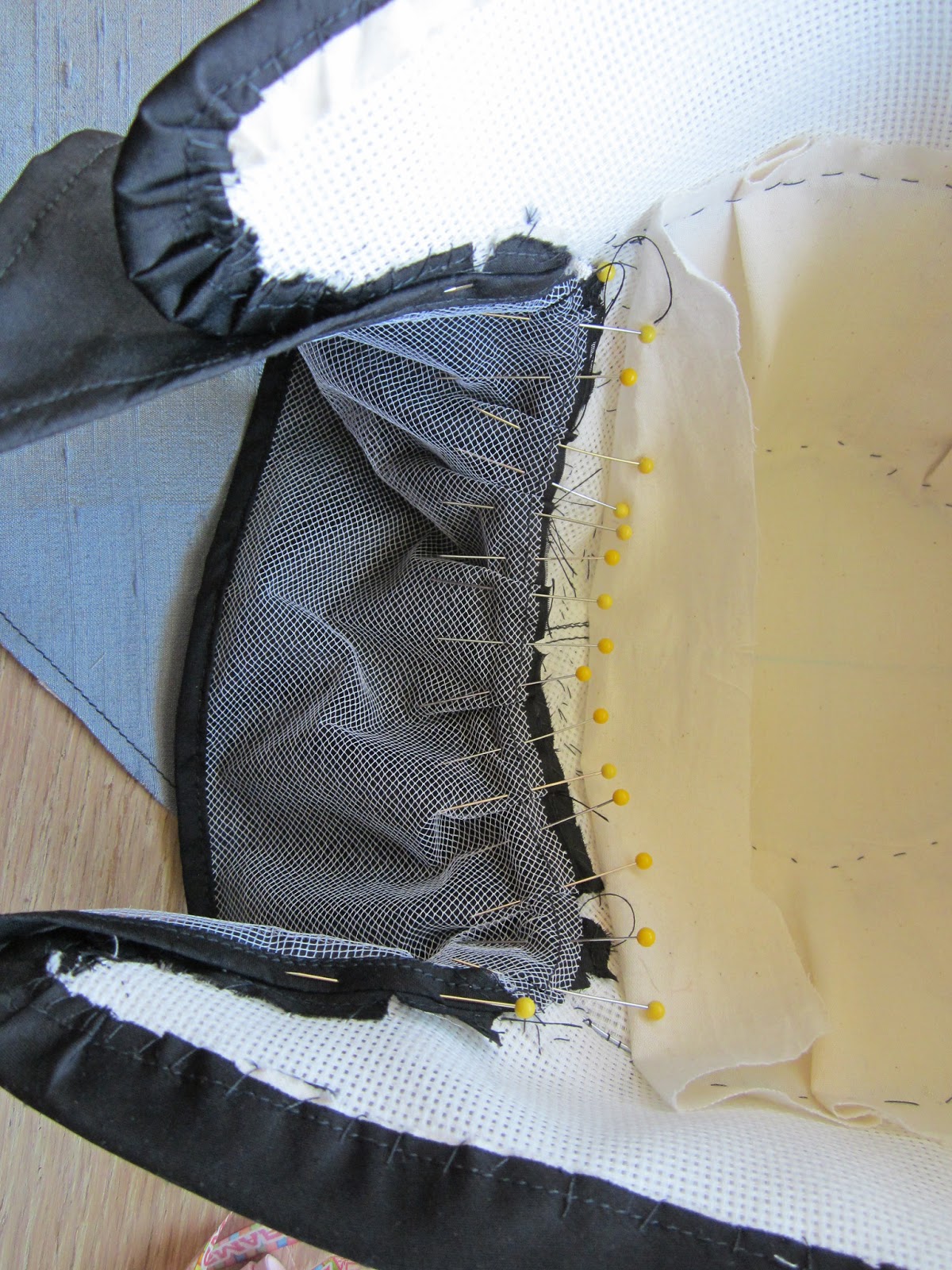
(Right now I'll tell you that this bonnet is too long for me on the tabs & bavolet, I have a short neck & it scrunches up... so you may want to make sure yours actually fits before you get to this point).
Stitch the bavolet on.
I left the tabs loose for now, you may want to stitch them on here.


OK, Everything look good?
Fix anything that isn't.

The brim lining can be raw if you are going to bind the edge with a finishing strip, or fold it over for a finished edge (that's what I did & it may change because it's uneven in places - see the right side of the pic?)

Feel free to decorate it however. Most of the ribbons come right off the cheek tabs, but I've seen a few that angle to the back neckline/cheek tab curve. Both inner brims & outsides were decorated in various ways: ribbons, silk flowers, netting, etc. If you want to stick with historic accuracy, find a fashion plate or museum piece to inspire you. If not, have at it.
Anna suggests adding a velvet ribbon to the inside brim where it sits on your head to help it "stick" in place.
Friday, May 17, 2013
Academics, Archeologists, Professionals & Weekend Researchers
Is it strange that most of my rant-posts come from Things People Have Said in online forums/groups?
Today got me thinking about Who The Experts Are, and who they aren't in terms of studying history, recreating it, etc. I got thinking about what "qualifications" are.
 Academics:
I'll include college professors, published historians, museum specialists & those who both study and publish their findings in journals, books, etc.
Obviously published academics in any given field fall into the Expert category, though many are specialists vs. generalists, which is good! They have a remarkable ability to shed light on a few aspects of life at a certain time & place, and while other aspects may escape them, their work in that area is invaluable especially for the generalist.
On the down-side (also an up-side), just about anyone can publish today, and unless there is a period of peer review pre-publication, the work may have areas that are highly suspect. One example of this is using Victorian Era sources as major references. While many are excellent, there was a general trend at the time to "fill in" missing information with speculation, opinions & outright fabrications to bulk out the book - ur, umm, I mean "findings." That work will also be colored by the author's academic environment (ie. politics), which is something to read with caution. Humm... sounds familiar... BUT, the moral of the story is, we have to be careful what we take as truth from literary sources & what we take as opinion or fabrication.
The best academics look at primary sources. Actual literature of the time, first hand accounts, etc.
Note: I just finished reading an excellent translation of an old manuscript where the translators took literally half the book to apologize for the original author's attitude toward women. After reading the actual translation, I found the author to be a totally normal man of his time and while he might have made a modern woman a little flustered, it certainly wasn't cause for actual hurling of knives or general verbal evisceration.
 Which brings me to...
Archeologists! (and pathologists, biologists, & whatever other "ologist" you can think of)
I do love archeologists. Wonderful people who have the Best Time Ever digging in the mud with garden trowels & paint brushes and then sifting literally tons of dirt for some speck of metal/wood/fabric/glass/bone that Means Something. Most excellent people! (oh, and their slaves too- I mean Interns! Yes Interns... that's the right word...)
Definitely experts, though you'll probably go home with a stomach ache from laughing so hard after you talk to them. They certainly have their own sense of humor (which is often edited out in their final publications).
The downside of archeological publications is that archeologists, like other people, come in different flavors. - You have the minimalists, who write like a police report. Just the facts, ma'am. (I actually like them quite a bit).
- You have the moderates, who give facts, a bit of context & maybe some speculation as to use, etc. around the object being discussed; they might link said item to similar items found Here. (I also greatly appreciate them).
- Then you have the dreamers, who give the facts, but then completely overshadow them in speculation, assumptions & embroidered stories about who/what/when/where/why/how and what they were thinking. (While fun to read, I cringe at this Victorian-ish writing style because it leaves so much room for error... much like the Always/Never folks). This is not to say that Dreamers aren't good archeologists, they just aren't very good writers... or rather they ARE very good writers, but they like stories a bit too much for my taste.
These first two categories are Experts, no matter if you agree with their conclusions/findings or not. These are the people from whom all others derive their knowledge. They are the base of the pyramid of history, so to speak.
The Pros:
 The next level of historic research is the Professionals. This includes Experimental Archeologists, Craftsmen, Artisans, independent researchers (who can be just as good if not better than academics) and people who do Talks/Demonstrations.
There is a wide variety of competence in this category: you have everything from "The Guy At The Country Village Who Bangs Out Horseshoes Once A Month" to "Scott the Gunsmith who makes hand-forged barrels, locks & stocks based on decades of research, different forging techniques & skill... and sells them for more money than I want to contemplate anyone ever spending on a firearm, but will teach a weekend history class that's worth more than a college education." (Can you tell that I like Scott?).
The long & short of it is that professionals make their living from selling their products, often based on years of research and skill development. While not all professionals are experts, many are, and what they have to say about their area of expertise should not be discounted. If you see someone who makes magnificent reproductions, don't hesitate to talk to them - they are a treasure trove of knowledge. Let the junk dealers sort themselves out (they have their place & they do fine in it).
 Weekend Researchers / Amateur Historians:
This category has the widest range of competence in it. Many people will focus in on one area of history (like fashion or wars or one battle in a war), and stay there. They become experts in that one thing and that's good enough. Others are generalists & want to see the flow and context of societies. They tend to get the gist of history, and are no less expert in that capacity than the others.
Some people will claim expert status based on having read one history book after college, or having joined some history club or other. Others won't ever share their interests but have more knowledge in the library of their skulls than Alexandria ever thought of containing.
Perhaps the point in this bit of a ramble is that you never know who will fall into the Expert category and who won't based on an online profile, academic title or what history club someone belongs to. The chick you just cut down for not being a Laurel in the SCA is one of the premier silver smiths at Colonial Williamsburg. Just because you don't know her & she doesn't hold a familiar title doesn't mean she doesn't know what she's talking about. Insulting someone who doesn't have a PhD, but has dedicated their life to experimental archeology - planting, growing, harvesting, processing, spinning & weaving flax into linen just to do it, one thing among the 1,000 things they've done... well, they deserve respect for doing it, and you may want to listen to them relay their real-world experiences.
Today got me thinking about Who The Experts Are, and who they aren't in terms of studying history, recreating it, etc. I got thinking about what "qualifications" are.

I'll include college professors, published historians, museum specialists & those who both study and publish their findings in journals, books, etc.
Obviously published academics in any given field fall into the Expert category, though many are specialists vs. generalists, which is good! They have a remarkable ability to shed light on a few aspects of life at a certain time & place, and while other aspects may escape them, their work in that area is invaluable especially for the generalist.
On the down-side (also an up-side), just about anyone can publish today, and unless there is a period of peer review pre-publication, the work may have areas that are highly suspect. One example of this is using Victorian Era sources as major references. While many are excellent, there was a general trend at the time to "fill in" missing information with speculation, opinions & outright fabrications to bulk out the book - ur, umm, I mean "findings." That work will also be colored by the author's academic environment (ie. politics), which is something to read with caution. Humm... sounds familiar... BUT, the moral of the story is, we have to be careful what we take as truth from literary sources & what we take as opinion or fabrication.
The best academics look at primary sources. Actual literature of the time, first hand accounts, etc.
Note: I just finished reading an excellent translation of an old manuscript where the translators took literally half the book to apologize for the original author's attitude toward women. After reading the actual translation, I found the author to be a totally normal man of his time and while he might have made a modern woman a little flustered, it certainly wasn't cause for actual hurling of knives or general verbal evisceration.

Archeologists! (and pathologists, biologists, & whatever other "ologist" you can think of)
I do love archeologists. Wonderful people who have the Best Time Ever digging in the mud with garden trowels & paint brushes and then sifting literally tons of dirt for some speck of metal/wood/fabric/glass/bone that Means Something. Most excellent people! (oh, and their slaves too- I mean Interns! Yes Interns... that's the right word...)
Definitely experts, though you'll probably go home with a stomach ache from laughing so hard after you talk to them. They certainly have their own sense of humor (which is often edited out in their final publications).
The downside of archeological publications is that archeologists, like other people, come in different flavors. - You have the minimalists, who write like a police report. Just the facts, ma'am. (I actually like them quite a bit).
- You have the moderates, who give facts, a bit of context & maybe some speculation as to use, etc. around the object being discussed; they might link said item to similar items found Here. (I also greatly appreciate them).
- Then you have the dreamers, who give the facts, but then completely overshadow them in speculation, assumptions & embroidered stories about who/what/when/where/why/how and what they were thinking. (While fun to read, I cringe at this Victorian-ish writing style because it leaves so much room for error... much like the Always/Never folks). This is not to say that Dreamers aren't good archeologists, they just aren't very good writers... or rather they ARE very good writers, but they like stories a bit too much for my taste.
These first two categories are Experts, no matter if you agree with their conclusions/findings or not. These are the people from whom all others derive their knowledge. They are the base of the pyramid of history, so to speak.
The Pros:
The next level of historic research is the Professionals. This includes Experimental Archeologists, Craftsmen, Artisans, independent researchers (who can be just as good if not better than academics) and people who do Talks/Demonstrations.There is a wide variety of competence in this category: you have everything from "The Guy At The Country Village Who Bangs Out Horseshoes Once A Month" to "Scott the Gunsmith who makes hand-forged barrels, locks & stocks based on decades of research, different forging techniques & skill... and sells them for more money than I want to contemplate anyone ever spending on a firearm, but will teach a weekend history class that's worth more than a college education." (Can you tell that I like Scott?).
The long & short of it is that professionals make their living from selling their products, often based on years of research and skill development. While not all professionals are experts, many are, and what they have to say about their area of expertise should not be discounted. If you see someone who makes magnificent reproductions, don't hesitate to talk to them - they are a treasure trove of knowledge. Let the junk dealers sort themselves out (they have their place & they do fine in it).

This category has the widest range of competence in it. Many people will focus in on one area of history (like fashion or wars or one battle in a war), and stay there. They become experts in that one thing and that's good enough. Others are generalists & want to see the flow and context of societies. They tend to get the gist of history, and are no less expert in that capacity than the others.
Some people will claim expert status based on having read one history book after college, or having joined some history club or other. Others won't ever share their interests but have more knowledge in the library of their skulls than Alexandria ever thought of containing.
Perhaps the point in this bit of a ramble is that you never know who will fall into the Expert category and who won't based on an online profile, academic title or what history club someone belongs to. The chick you just cut down for not being a Laurel in the SCA is one of the premier silver smiths at Colonial Williamsburg. Just because you don't know her & she doesn't hold a familiar title doesn't mean she doesn't know what she's talking about. Insulting someone who doesn't have a PhD, but has dedicated their life to experimental archeology - planting, growing, harvesting, processing, spinning & weaving flax into linen just to do it, one thing among the 1,000 things they've done... well, they deserve respect for doing it, and you may want to listen to them relay their real-world experiences.
Saturday, April 13, 2013
The Problem of Racism in Reenacting
WARNING:
Someone's feelings will get hurt.
Someone will be insulted.
Someone will take offense.
You'd better because it's cause for hurt, insult and offense.
I got suddenly & quite surprisingly upset this morning about an article on hidden racism in Goth circles, which you can read here (it's quite good). I didn't get upset because of the Goths, I got upset because in my own dear social circle racism is positively rampant (let's not even broach the issue of sexuality, they aren't ready for the science). Sometimes it's hidden, sometimes it's all out in the open for the world to see... probably depends on the weather & how much is left in the flask.
You see, Reenacting has a Racism Problem.
I know, News Flash, right?
But to me, it was a surprise. I just (innocently & obliviously) figured that black people just didn't want to reenact a painful and difficult time in American history and so naturally gravitated to earlier or later time frames, like the SCA or Civil War era. In part, this may have some truth to it, but there were truly shining moments for black Americans in the 1600's-1800's and we lose something beyond measure by ignoring that history. We lose an entire cross-section of our society.
Then in 2011 my eyes and ears got opened. Not pretty. What I had taken as bad jokes in poor taste -for years- turned out to be comments & commentary that were said in all seriousness.
"Come over here and sit with the White Folks where you belong."
"I hate the N----s."
"It were the Africans & Hitler what spread AIDS"
countless others...
Then, in 2011 the call went up.
"White Power!"
It traveled from the man in front of me, down the roadway, skipping tents here & there but always carried on; some voices I knew and some I didn't until it'd gone from one end to the other like a shock-wave through camp, so many I lost count and for days I could hear that echo.
My heart broke that day.
You see, there are hundreds of good, honest, loving, accepting people in reenacting. Many of them are very dear friends who would welcome anyone with a genuine interest in the hobby.
And then there are These Guys.
You want to come play with them? No? Neither do I.
Really, it only takes one or two turds to empty a pool. We've got a mess of diarrhea floating in the shallow end.
I thought the sexism was bad, but quite frankly, having grown up in this hobby, wading through the opinions of Misogynistic Mountain Men is a minor annoyance; and they all know I'll gut them in a heartbeat if they put a hand in the wrong place... but somehow being threatened on a generic gender level with a bit of sexual harassment isn't nearly as shocking as realizing that these people, many of whom I truly like, could and would actually hurt someone for the color of their skin. They actually, actively Hate people based on skin pigment.
Why am I so surprised? I grew up hearing the n-word... though as it fell out of use my memory faded...
Because somewhere along the line, I got the idea that people were better than this today; that society's heart had changed, become kinder. I found a nice pair of rose colored glasses & slipped them on without noticing.
Well, a couple years ago the glasses got cracked. The Headphones of Happiness got removed & I hear you now.
So, when my friends ask me "what camps are you coming to? we miss you," I have to think long & hard about where I'm going and who I'll visit with. I'll always wonder if your voice was one that was raised in that horrible call. I can't see you through the veil of history anymore; I'll always wonder if you carry your modern (if outdated) ideals, prejudices & attitudes with you into this pretend past. I'll always wonder if you hate me because I have the brown eyes and black hair of my possibly less than Lilly-White ancestors.
So the next time a group of school kids comes through camp and asks the painfully obvious question "where are all the black people?" you'll have to ask yourself if you are going to tell them the cold, hard truth or give them a spoonful of sugar with the poisonous lie.
It's a hard pill to choke on, Ladies & Gents. To think that those of us who love history with such a burning passion would purposely exclude an entire race of people who contributed just as much as our own ancestors to the building of this country... A very hard pill to choke on indeed.
Note: There are a few black reenactors in the 1640-1840 scene, and I give them all the credit in the world. They are braver than I am, that's for sure... though I've never asked if they sleep with knives too.
Someone's feelings will get hurt.
Someone will be insulted.
Someone will take offense.
You'd better because it's cause for hurt, insult and offense.
 |
| 1821 Public House in London, Crookshanks |
I got suddenly & quite surprisingly upset this morning about an article on hidden racism in Goth circles, which you can read here (it's quite good). I didn't get upset because of the Goths, I got upset because in my own dear social circle racism is positively rampant (let's not even broach the issue of sexuality, they aren't ready for the science). Sometimes it's hidden, sometimes it's all out in the open for the world to see... probably depends on the weather & how much is left in the flask.
You see, Reenacting has a Racism Problem.
I know, News Flash, right?
But to me, it was a surprise. I just (innocently & obliviously) figured that black people just didn't want to reenact a painful and difficult time in American history and so naturally gravitated to earlier or later time frames, like the SCA or Civil War era. In part, this may have some truth to it, but there were truly shining moments for black Americans in the 1600's-1800's and we lose something beyond measure by ignoring that history. We lose an entire cross-section of our society.
Then in 2011 my eyes and ears got opened. Not pretty. What I had taken as bad jokes in poor taste -for years- turned out to be comments & commentary that were said in all seriousness.
"Come over here and sit with the White Folks where you belong."
"I hate the N----s."
"It were the Africans & Hitler what spread AIDS"
countless others...
Then, in 2011 the call went up.
"White Power!"
It traveled from the man in front of me, down the roadway, skipping tents here & there but always carried on; some voices I knew and some I didn't until it'd gone from one end to the other like a shock-wave through camp, so many I lost count and for days I could hear that echo.
My heart broke that day.
You see, there are hundreds of good, honest, loving, accepting people in reenacting. Many of them are very dear friends who would welcome anyone with a genuine interest in the hobby.
And then there are These Guys.
You want to come play with them? No? Neither do I.
Really, it only takes one or two turds to empty a pool. We've got a mess of diarrhea floating in the shallow end.
I thought the sexism was bad, but quite frankly, having grown up in this hobby, wading through the opinions of Misogynistic Mountain Men is a minor annoyance; and they all know I'll gut them in a heartbeat if they put a hand in the wrong place... but somehow being threatened on a generic gender level with a bit of sexual harassment isn't nearly as shocking as realizing that these people, many of whom I truly like, could and would actually hurt someone for the color of their skin. They actually, actively Hate people based on skin pigment.
Why am I so surprised? I grew up hearing the n-word... though as it fell out of use my memory faded...
Because somewhere along the line, I got the idea that people were better than this today; that society's heart had changed, become kinder. I found a nice pair of rose colored glasses & slipped them on without noticing.
Well, a couple years ago the glasses got cracked. The Headphones of Happiness got removed & I hear you now.
So, when my friends ask me "what camps are you coming to? we miss you," I have to think long & hard about where I'm going and who I'll visit with. I'll always wonder if your voice was one that was raised in that horrible call. I can't see you through the veil of history anymore; I'll always wonder if you carry your modern (if outdated) ideals, prejudices & attitudes with you into this pretend past. I'll always wonder if you hate me because I have the brown eyes and black hair of my possibly less than Lilly-White ancestors.
So the next time a group of school kids comes through camp and asks the painfully obvious question "where are all the black people?" you'll have to ask yourself if you are going to tell them the cold, hard truth or give them a spoonful of sugar with the poisonous lie.
It's a hard pill to choke on, Ladies & Gents. To think that those of us who love history with such a burning passion would purposely exclude an entire race of people who contributed just as much as our own ancestors to the building of this country... A very hard pill to choke on indeed.
Note: There are a few black reenactors in the 1640-1840 scene, and I give them all the credit in the world. They are braver than I am, that's for sure... though I've never asked if they sleep with knives too.
Friday, March 29, 2013
Quick Thoughts on Blogging
I know people use blogs for 10,000 different things, and that's why I adore this medium.
But I want to clear up some misconceptions about what I use this blog for.
While I have some semi-serious research on here, some crack-pot theories, some great tutorials, and some awesome "this is how I made this" garment diaries, this is not a place for uber-super-serious academic scholarship (as you can tell by my Valley Girl chirping of "uber-super-serious"). That doesn't mean that I'm not serious about my research. It just means that chances are, you won't find the actual stuffy-academic paper here. You're going to get the layman's version.
So that's clear, right?
The reason I'm bringing this up is that in the past 3 weeks or so, there have been several online discussions where bloggers (and some of them are indeed serious academic researchers) have self-referenced their own blog posts as serious academic sources. These blog posts did not, in fact, contain any historic references of any kind, no citations, no original quotes - some pictures, yes, (but they weren't even labeled with the museums or original publications)... but the words contained in the posts were those of the blog authors drawing their own conclusions about their own research. Which is fine. That's what research is for. It's just not a suitable reference source. You can't cross-check research that doesn't have references.
So, dear blog readers; please be careful about listing your references, or please refrain from being self-referential. You may well be "the best in the business" in your area of study, but without a bibliography post-post... it's useless to the rest of the world, and makes you look less professional than you may actually be.
Hopefully no one is mortally offended, but it's something to bare in mind.
Serious Research = Bibliography.
No References = Just For Fun.
Subscribe to:
Posts (Atom)